Electronic Supplement to
Sensitivity Densities for Rotational Ground Motion Measurements
by Andreas Fichtner and Heiner Igel
The apparent shear wave speed βa is defined as half the ratio of the rms amplitude of the rotational ground motion ω(xr,t) and the rms amplitude of the displacement velocity v(xr,t) measured over time t at some location xr. In the case of a plane S wave, βa is equal to the true S velocity β. Since measurements of the rotational ground motion ω become increasingly feasible (Nigbor, 1994; Pancha et al., 2000; Igel et al., 2005, 2007), it is natural to incorporate them into structural inverse problems. For this it is necessary to know how the apparent shear wave speed βa senses the Earth's structure.
Based on the operator formulation of the adjoint method (Fichtner et al., 2006) we derived expressions for the relative sensitivity densities, δβln βa, of the apparent shear wave speed βa with respect to the true shear wave speed β. The most important property of the βa kernels is that they attain large values only in the vicinity of the receiver but not in the vicinity of the source. Thus, βa is rather insensitive to structure far from the receiver. It may therefore be used to image crustal structures even when the structural details in the deeper Earth are poorly known.
The following images show slices through 3-D sensitivity kernels of the apparent shear wave speed βa; The numbering of the figures corresponds to the numbering in the paper.
Figures

Figure 2: Slices through the rotation amplitude kernels δβln Aω and the apparent shear wave speed kernels δβln βa in the one-dimensional Earth model ak135 (Kennett et al., 1995). The source is located at the depth of 300 km (star) and the direct S wave is recorded at an epicentral distance of 650 km (triangle). The cutoff period of the signal is 10 s. a) Horizontal slices at the surface through the rotation amplitude kernel δβln Aω (top) and the apparent shear wave speed kernel δβln βa (below). Both kernels attain their largest values directly at the receiver position. b) As a) but at the depth of 100 km. c) Vertical slices through δβln Aω (top) and δβln βa (below). The absolute values of the βa kernel decrease away from the receiver, so that βa measurements are most sensitive to the Earth structure near the receiver and less sensitive to structures at greater distances.

Figure 3: Slices through the apparent shear wave speed kernel δβln βa for a cutoff period of 20s. Left: Horizontal slice at the surface. The geometry of the kernel is similar to the 10 s version in figure 2 a) but has a significantly wider lateral extension. Center: Horizontal slice at the depth of 100 km. The geometry of the kernel differs from the one of the 10 s version. Right: Vertical slice parallel to the source-receiver line. The kernel is concentrated near the receiver, whereas its absolute values decrease towards the source.
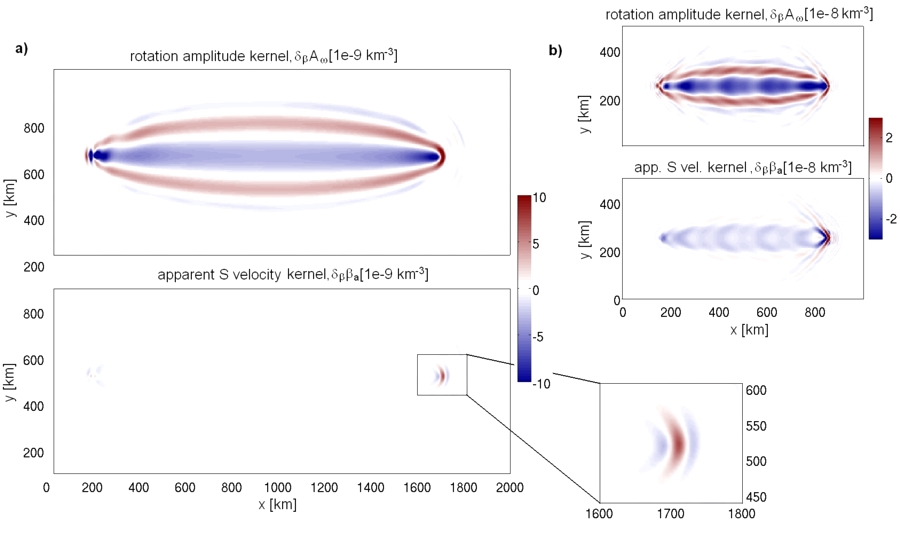
Figure 5: a) Horizontal slices at 10 km depth through the rotation amplitude kernel δβln Aω (top) and the corresponding apparent shear speed kernel δβln βa (below). The epicentral distance is 1500 km. b) The same as a) but for a shorter epicentral distance of 650 km.

Figure 6: Vertical slices through the kernel δβln βa along the source-receiver line. The image is plotted with different color scales in order to emphasize the different amplitudes of the kernel in the source and receiver regions.
References
Fichtner, A., Bunge H.-P., Igel, H., (2006). The adjoint method in seismology - I. Theory, Phys. Earth Planet. Int., 157, 86-104.
Igel, H., Schreiber, U., Flaws, A., Schuberth, B., Velikoseltsev, A., Cochard, A. (2005). Rotational motions induced by the M8.1 Tokachi-oki earthquake, September 25, 2003, Geophys. Res. Letters, 32, L08309.
Igel, H., Cochard, A., Wassermann, J., Flaws, A., Schreiber, U., Velikoseltsev, A., Dinh, N. P. (2007). Broad-band observations of earthquake-induced rotational ground motions, Geophys. J. Int., 168(1), 182-197.
Kennett, B. L. N., Engdahl, E. R., Buland, R. (1995). Constraints on seismic velocities in the Earth from traveltimes, Geophys. J. Int., 122, 108-124.
Nigbor, R. L. (1994). Six-degree-of-freedom ground-motion measurement, Bull. Seis. Soc. Am., 84(5), 1665-1669.
Pancha, A., Webb, T. H., Stedman, G. E., McLeod, D. P., Schreiber, K. U. (2000). Ring laser detection of rotations from teleseismic waves, Geophys. Res. Letters, 27(21), 3553.3556.