Electronic Supplement to
Numerical Simulation of Ground Rotations along 2D Topographical
Profiles under the Incidence of Elastic Plane Waves
by L. Godinho, P. Amado Mendes, A. Tadeu, A. Cadena-Isaza, C. Smerzini, F. J. Sánchez-Sesma, R. Madec and D. Komatitsch
Analysis of the dependence of rotational motion on incident plane-wave frequency
In the text of the main paper, a parametric study concerning the amplification of rotational motion in the presence of different topographies is presented for the normalized frequency η = 1. As stated in the text, no results were presented for other frequencies. However, a systematic study has been conducted analyzing the relation of both displacements and rotations with frequency. Below, a number of examples is presented illustrating the behavior of two geometries, namely a semicircular canyon (Figure E1) and a triangular valley (Figure E2), for three different values of the normalized frequency (η = 1, 2 and 3).
For the semicircular canyon, it can be seen that the results for higher frequencies (see Figure E3) are very consistent with those presented in the main text for η = 1. Indeed, for higher frequencies, as the incidence angle grows, higher amplifications are also registered at the central part of the canyon, with the normalized rotations reaching maximum values of about 9 for SV waves with γ = 60º. For these higher frequencies, it can also be seen that additional oscillations appear in the response. For the case of the incident Rayleigh wave (Figure E4),this oscillatory behavior can also be observed. When the geometry is that of a triangular valley (Figures E5 and E6), the amplifications of both displacements and rotations are smaller, although the computed responses reveal a very similar behavior to that identified before for the semi-circular canyon.
The results illustrated here confirm the findings stated in the main text. In fact, the conducted study allowed the authors to analyse the relation of both displacements and rotations with frequency. In this analysis, the authors found that, as a general tendency, a similar behavior is registered, but the responses tend to exhibit more pronounced spatial oscillations as the frequency increases. The analysis of these results indicates that the influence of the topographical feature is further enhanced with respect to the case of η = 1.
Figures
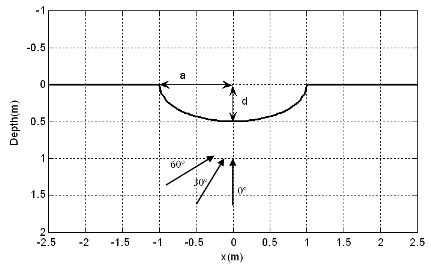
Figure E1. Geometry of an elliptical canyon, defined by parameters a (half the width) and d (depth).
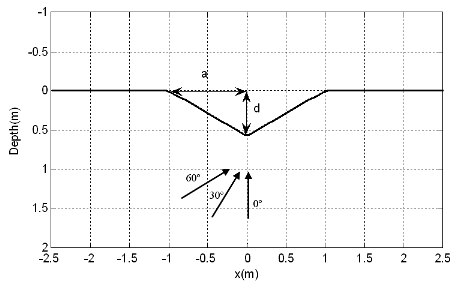
Figure E2. Geometry of a triangular valley, defined by parameters a (half the width) and d (depth).
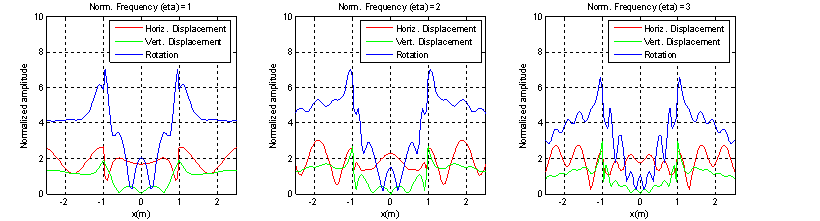
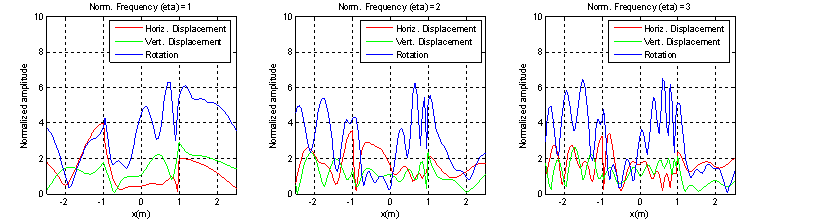
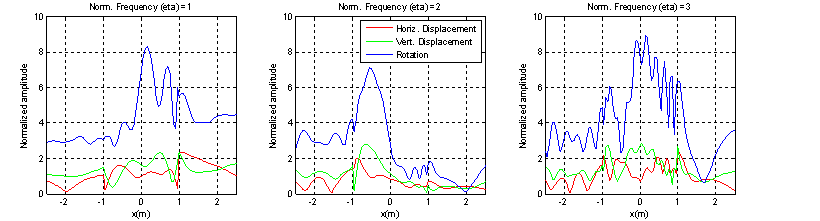
Figure E3. Results obtained for a semicircular canyon (a=1 m and d=1 m) under the incidence of SV waves with different inclinations: a) 0º; b) 30º; c) 60º.
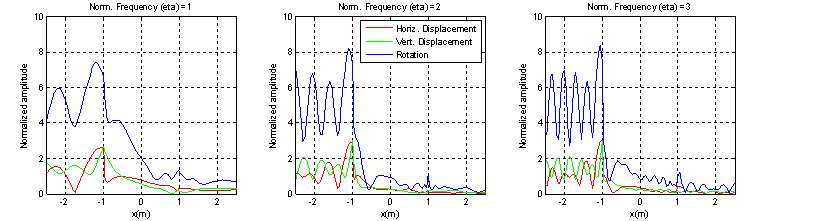
Figure E4. Results obtained for a semicircular canyon (a=1 m and d=1 m) under the incidence of a Rayleigh wave.
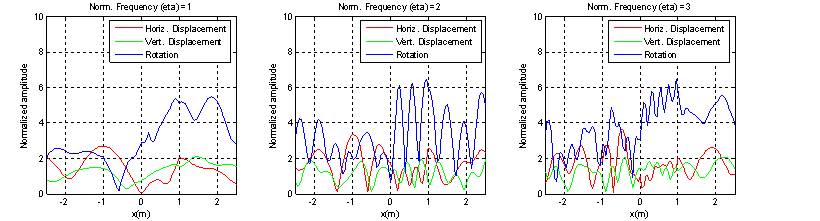
Figure E5. Results obtained for a triangular valley (a=1 m and d=1 m) under the incidence of a SV wave at 30º.
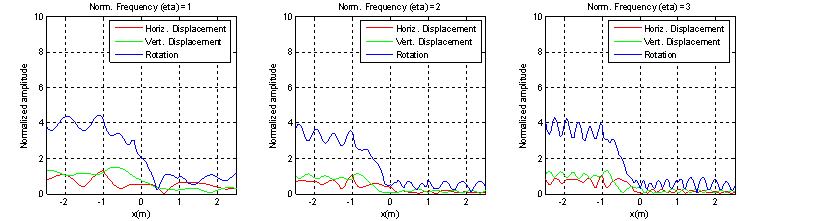
Figure E6. Results obtained for a triangular valley (a=1 m and d=1 m) under the incidence of a Rayleigh wave.