In the following we give some details of the moment tensor inversions presented in the paper. We provide background information on moment tensor decompositions, particularly for the crack+DC inversion. Furthermore, we derive the scaling of the scalar moment. The results of each inversion run are compiled in a table.
Background Information on Moment Tensor Inversions. Details on full, deviatoric and crack+DC inversions. The meaning for different source types in a glaciological context is given. We discuss the meaning of isotropic, deviatoric, double-couple and CLVD moment tensors and how a moment tensor can be decomposed into these elements. The determination of the scalar moment in view of the frequency-distance scaling is explained further.
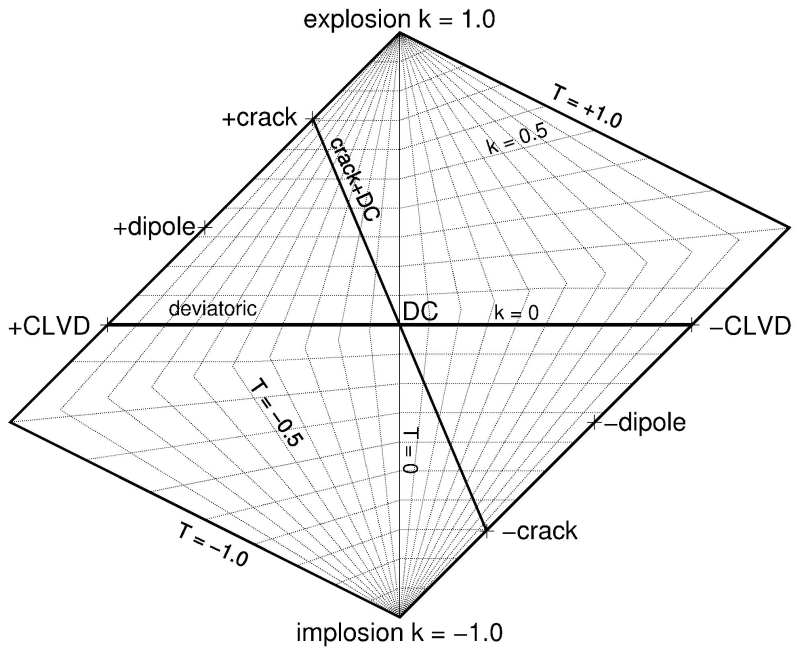
Grid for source-type plots after Hudson et al. (1989). The value T (near vertical grid lines) characterizes the deviation of the deviatoric part of the moment tensor from a pure double-couple, whereas k (near horizontal grid lines) is a measure of the strength of the isotropic component. Any given area on the plot is proportional to the probability that the (T,k) values of a completely random moment tensor lie within this area (hence the distorted shape of the source-type plot). The locations of basic source mechanisms such as double-couple, explosion, crack, dipole and CLVD are marked. Whereas (T,k) values of an unconstrained moment tensor can lie anywhere within the plot area, the solutions of deviatoric and crack+DC moment tensors lie on the indicated lines.
Results of Moment Tensor Inversions. Table with the results of full, deviatoric and crack+DC moment tensor inversions for each event discussed in the paper.