The William B. Joyner Memorial Lecture series was established by SSA in cooperation with the Earthquake Engineering Research Institute (EERI) to honor Bill Joyner’s distinguished career at the U.S. Geological Survey (USGS) and his abiding commitment to the exchange of information at the interface of earthquake science and earthquake engineering. Joyner Lecturers are chosen on the basis of their work at this interface, whether it involves contributions from earthquake science to earthquake engineering, or from earthquake engineering to earthquake science. The lectures are supported by donations to the William B. Joyner Memorial Fund.
Presented at the Annual Meetings of the SSA and EERI, as well as at locations of the lecturer’s choosing, the lectures bring scientists and engineers together in an effort to make our world a safer one–just as Joyner himself did so brilliantly.
Watch the 2024 Joyner Lecture by Helen Crowley.
Nomination Procedure
Nominations can be made by any member of EERI or SSA. The chosen recipient of this award, inspired by William B. Joyner’s dedication to information exchange at the junction of earthquake science and earthquake engineering, must satisfy the following criteria: firstly, they should be a member of either the Seismological Society of America (SSA) or the Earthquake Engineering Research Institute (EERI). Secondly, they must have demonstrated a strong professional commitment to facilitating the exchange of information between earthquake science and earthquake engineering. Lastly, their professional history should showcase noteworthy contributions either from earthquake science to earthquake engineering or vice versa, demonstrating a substantial impact on strengthening the interface between these two fields.
The Joyner Lecturer is selected by the Joyner Committee each year. EERI and SSA waive meeting registration fees for the Joyner Lecturer and provide travel funds to attend the Annual Meeting of each organization. For more information about the rules regarding this award, read our Honors Program Guide.
The Joyner Committee is chaired by Ricardo Taborda and includes Domniki Asimaki, Jeff Bayless, Jonathan Stewart, Karen Luttrell and Julian Bommer
Nomination Materials
- A nomination letter of no more than two pages. The letter must clearly document the nominee’s accomplishments that foster and enhance the earthquake-science/earthquake- engineering interface and explain why these accomplishments have made a positive impact on the state of knowledge and practice in earthquake engineering and seismology. This letter must be endorsed by three additional persons, either by adding their signature to the nominating letter or by providing additional individual letters of support (also no more than two pages each, and no more than three in total). These additional persons or signatories do not need to be SSA or EERI members.
- Either a Curriculum Vitae for the nominee or a substantial summary of the professional history of the candidate. This may include honors, awards, professional affiliations, lectures and publications, and professional service and experience that address the intent of the Joyner Lecture Award.
- Additionally, the chief nominator must complete and submit this online ethics disclosure form for every nominee. The nomination is not considered final/received until the form is completed. Click here to complete the Ethics Disclosure Form for Nominators.
The annual deadline for Joyner nominations is 30 June. Please submit the application to awards@seismosoc.org.
About William B. Joyner
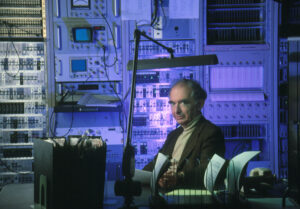
William (“Bill”) B. Joyner (1929-2001) grew up in Nebraska, and received his A.B., A.M., and Ph.D. degrees from Harvard University. He joined the Regional Geophysics Branch of the USGS as a geophysicist in 1964, working on computer analysis of gravity and magnetic data. From 1967 to 1970 Joyner was assigned to the national headquarters of the USGS as the staff geophysicist for the Office of Earthquake Research (1967-1969) and the Office of Geochemistry and Geophysics (1969-1970). While serving in Washington he wrote a substantial part of the “Proposal for a Ten-Year National Earthquake Hazards Program,” which was important in initiating the highly regarded USGS program in earthquake hazard reduction. In 1970 he stepped down from administrative duties and became a project scientist in the Western Region Headquarters of the USGS, where he concentrated his research on the prediction of earthquake ground motion for engineering design. He made many fundamental contributions to that field, including developing numerical methods for calculating nonlinear soil response in one and two dimensions, deriving what became the industry-standard equations for predicting strong ground motion from earthquakes, and, most recently, describing the essential features of surface-wave generation and propagation in deep sedimentary basins. From 1999 until shortly before his death, he directed the USGS National Strong-Motion Program. Joyner was particularly effective at bridging the gap between seismologists and engineers, serving on numerous code-writing committees for the Structural Engineers Association of Northern California and the Building Seismic Safety Council. In recognition of his contributions and service, he was awarded the Department of the Interior’s highest honor, the Distinguished Service Award, in 2000. His technical contributions, wisdom and humor are missed by his many friends and former colleagues in the SSA community.
2026 Joyner Lecturer
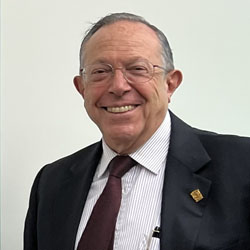
Francisco José Sánchez-Sesma, professor at the Universidad Autónoma de Mexico (UNAM) is honored for decades of research aimed at understanding and modeling seismic wave propagation in complex geological media and its manifestations in ground motion, from strong shaking during large earthquakes to weak ambient vibrations such as microtremors and seismic noise.
These efforts integrate the analysis of recorded data with analytical and numerical modeling, including geometric representations to capture the complexity of the resultant wavefield.
Sánchez-Sesma’s contributions to theory and method throughout his career have made a significant impact on seismic hazard assessment in earthquake engineering, aided by his early background as a structural engineer. He is best known for his contributions to methods, such as the Indirect Boundary Element Method (IBEM), for studying seismic wave propagation, especially amplification of seismic waves by complex 3D surface geological structures.
Sánchez-Sesma’s mastery of mathematical formulations, his development of new techniques of numerical simulations of wave propagation and techniques for data processing for seismic imaging were noted in his nomination for the Joyner award.