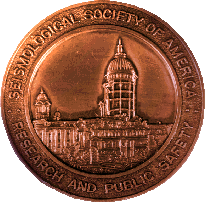
 With a distinguished list of recipients that reads like a Who’s Who in the field of seismology, The Harry Fielding Reid Medal is SSA’s highest honor. Originally called The Society Medal before its name change in 2005, the award has celebrated outstanding contributions to seismology or earthquake engineering since 1976.
Award Criteria
The Harry Fielding Reid Medal, SSA’s highest honor, is awarded no more than once a year for outstanding contributions in seismology or earthquake engineering.
Award Eligibility
The Medal may be awarded to any individual with the exception of a member, member-elect or officer of the SSA Board of Directors at the time of the nomination deadline.
Nomination Procedure
The chief nominator must be an SSA member who is eligible to submit a nomination. Any member of SSA may nominate a candidate for this award, with the exception of members of the Reid Medal subcommittee, SSA Board of Directors and SSA Award Encouragement Committee.
A nomination package consists of: 1) a letter of nomination of no more than two pages that summarizes the nominee’s significant accomplishments; 2) at least two but no more than five letters of support, with at minimum two letters originating from members of the Society; 3) Non-members of SSA may co-sign letters of support or originate letters; 4) Letters may have multiple authors, but the total number of authors summed across all support letters must not exceed ten; and 5) Letters of support may be no longer than two pages. Optionally, the package may include a curriculum vita and bibliography in support of the nominee.
A signed nominator disclosure form submitted by the chief nominator must be included with every submission. Click here to complete the Ethics Disclosure Form for Nominators.
The Medal Subcommittee should attempt to ensure that up to but no more than three nominees are put forward for consideration by the Board for the Medal annually. If the subcommittee feels there is no qualified recipient, they will recommend that no award be conferred that year. Any unsuccessful nomination may be considered again in the following year’s award cycle without resubmission of the nomination package if requested by a nominator before 30 September of that year. To be reconsidered in subsequent years (beyond the year immediately following the original nomination), a new nomination package must be submitted. The Executive Director will contact nominators via email prior to 30 September to confirm willingness for reconsideration of a package for a second year.
Awardee Selection
The Board of Directors will select the recipient of the Medal from among the one to three nominees provided to the Board from the Reid Subcommittee. The HC may review the procedures and/or act in an advisory capacity to the subcommittee. The HC, the SSA Board and staff should keep names of nominees and nomination materials confidential.
Subcommittee Membership
The subcommittee consists of six persons, including the chair. All subcommittee members must be SSA members. One member of the subcommittee, preferably the chair, should also be a member of the HC. Subcommittee membership may include no more than two past Medalists and would ideally include early-career and mid-career SSA members. Normal term of service is two years, with the chair serving for two years.
Deadline and More Details
Nominations should be sent to the SSA Secretary by 30 September, midnight PST. Electronic submissions should be e-mailed in .TXT, .PDF or .DOC files to awards@seismosoc.org.
For more information, see the SSA Honors Program Guide.
2026 Harry Fielding Reid Medal Recipient

Peter Shearer, professor of geophysics at Scripps Institution of Oceanography, University of California, San Diego, is the recipient of the 2026 Harry Fielding Reid Medal.
Shearer is recognized as one of the leading observational seismologists of his generation, noted for his outstanding contributions to improving earthquake locations and other source properties and his research delineating the structure and dynamics of Earth’s mantle and core.
Shearer is perhaps best known for his efforts to develop methods of precisely determining earthquake locations, which have led to further insights into fault interactions, seismic stress release, and the physics behind earthquakes. He and his colleagues were some of the first to systematically reprocess whole earthquake catalogs to improve locations. Shearer’s relocated earthquake catalogs and focal mechanisms for southern California have become standards used across hundreds of studies.
His work “stacking” thousands of seismograms from events around the globe to study the deeper layers of the Earth have confirmed significant mantle discontinuities, and his mining and analysis of large data sets have revealed small-scale heterogeneities in the mantle and core. These studies have helped to bridge seismology with geodynamics and mineral physics research in the quest for a clearer picture of Earth’s dynamics and long-term evolution.