
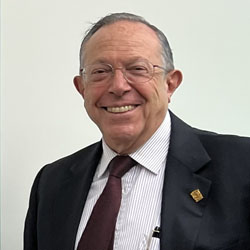
 Francisco José Sánchez-Sesma, professor at the Universidad Autónoma de Mexico (UNAM) is honored for decades of research aimed at understanding and modeling seismic wave propagation in complex geological media and its manifestations in ground motion, from strong shaking during large earthquakes to weak ambient vibrations such as microtremors and seismic noise.
These efforts integrate the analysis of recorded data with analytical and numerical modeling, including geometric representations to capture the complexity of the resultant wavefield.
Sánchez-Sesma’s contributions to theory and method throughout his career have made a significant impact on seismic hazard assessment in earthquake engineering, aided by his early background as a structural engineer. He is best known for his contributions to methods, such as the Indirect Boundary Element Method (IBEM), for studying seismic wave propagation, especially amplification of seismic waves by complex 3D surface geological structures.
His encounters with Bessel functions and with Quantitative Seismology, the influential 1980 book by Keiiti Aki and Paul Richards, “provided tools and a rigorous framework to understand reflection, transmission, and diffraction, concepts of waves that initially seemed almost magical,” said Sánchez-Sesma.
Sánchez-Sesma’s mastery of mathematical formulations, his development of new techniques of numerical simulations of wave propagation and techniques for data processing for seismic imaging were noted in his nomination for the Joyner award.
Beyond his numerous contributions to the global practice of seismology and earthquake engineering, Sánchez-Sesma has demonstrated significant science and engineering leadership throughout Latin America. He and his colleagues provided key guidance in developing a new building code for Mexico after the devastating 1985 [Mw 8.1] Michoacán earthquake in Mexico City.
The Carnegie Institution of New York appointed Sánchez-Sesma to serve from 2017 to 2019 as a member of the Working Group of the Inter Academy Partnership for the UN agenda 2030. He was the only member from the Latin American region.
Among his notable positions, Sánchez-Sesma served as president of the Mexican Society of Earthquake Engineering from 2001 to 2003 and was the president of the Mexican Academy of Engineering from 2004 to 2006. He received his BSc in civil engineering in 1974 and his MSc (1975) and Ph.D. (1979) in structural engineering from UNAM.