2 February 2026—The Earthquake Engineering Research Institute (EERI), the Consortium of Organizations for Strong Motion Observation Systems (COSMOS) and SSA are pleased to announce that Eduardo Miranda of Stanford University is the recipient of the 2026 Bruce Bolt Medal.
Miranda was recognized for his contributions in developing new ground motion models and intensity measures, refining damping modification factors, and improving methods for assessing seismic demands on structures and nonstructural components. His work has shaped seismic design provisions, and he has emphasized the use of strong-motion data in both research and teaching.
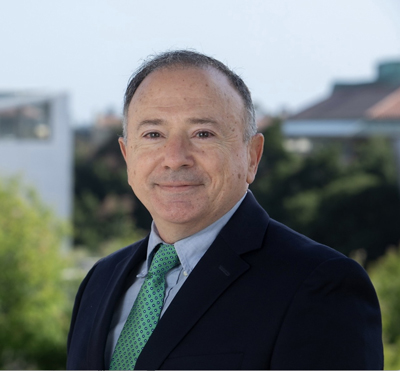 The award will be presented to Miranda at the 2026 U.S. National Conference on Earthquake Engineering and EERI Annual Meeting in Portland, Oregon.
The Bruce Bolt Medal honors the legacy of Bruce Alan Bolt (1930-2005), a pioneer at the intersection of earthquake science and earthquake engineering. Both an internationally recognized seismologist and an elected member of the National Academy of Engineering, he served as founding president of COSMOS, president of SSA, president of the International Association of Seismology and Physics of the Earth’s Interior (IASPEI), and chair of the California Seismic Safety Commission.
The medal is awarded jointly by EERI, COSMOS and SSA to recognize individuals worldwide who work at the intersection of seismology and earthquake engineering, whose accomplishments involve the promotion and use of earthquake measurements, and whose leadership in the transfer of scientific and engineering knowledge into practice or policy has led to improved seismic safety.
Miranda is a professor in the department of civil and environmental engineering at Stanford, where he specializes in performance-based earthquake engineering. For nearly four decades, he has made extensive use of strong motion records, both installed on the ground surface and on structures, in his research.
His research contributions span a broad range of topics, including improved estimation of seismic demands for structures built on soft soils; development of parameters to estimate seismic demands on structures behaving nonlinearly from peak elastic response—such as strength reduction factors, inelastic displacement ratios, residual drift demands, and assessment of seismic demands on nonstructural components. He has also significantly contributed to developments in ground motion modeling, including models for estimating peak inelastic displacement, new intensity measures strongly correlated to structural collapse, intra-event variability of spatial correlation, and, more recently, ground motion directionality.
Miranda is the recipient of several honors, including the Moisseiff Award from the American Society of Civil Engineers and recognition as a “Top 25 Newsmaker” by Engineering News Record. He is a corresponding member of the Mexican Academy of Engineering and has served as co-chair of the Learning From Earthquakes program of the Earthquake Engineering Research Institute.
He obtained his civil engineer degree from the National Autonomous University of Mexico (UNAM) in 1986, followed by his MSc (1988) and Ph.D. (1991) degrees in structural engineering from the University of California, Berkeley.