
1 April 2026—Slow roiling convection currents deep within the Earth’s mantle, which are associated with the movements of tectonic plates, also deform the material of the mantle itself.
Now, a new study in The Seismic Record confirms that much of this deformation in the lowest level of the mantle occurs where researchers think there may be deeply subducted tectonic slabs.
Researchers had suspected this might be the case, but the study provides a global look at the phenomenon for the first time, sampling nearly 75% of the lowest mantle layer just above the core-mantle boundary, about 2,900 kilometers below the surface.
Jonathan Wolf at the University of California, Berkeley and colleagues created this global map after collecting and analyzing an unprecedented database of more than 16 million seismograms from 24 data centers around the world.
Shear waves created by earthquakes can travel at different speeds depending on which direction they travel through a material, guided by the structure and composition of the material itself. This phenomenon, called seismic anisotropy, helps scientists pinpoint areas of mantle deformation.
These patterns of deformation, in turn, can help researchers understand more about mantle convection.
“We know that deformation in the upper mantle is dominated by the drag of the plates that move across it. And that extremely well approximates what we know from seismic anisotropy about the deformation of the upper mantle,” Wolf explained. “But we don’t have any of this kind of large-scale understanding for flow in the lowermost mantle. And that’s really what we want to get at.”
From their massive seismogram database, which Wolf thinks may be “the largest-ever assemblage of earthquake seismic data,” the researchers analyzed different phases of seismic waves that moved through the mantle into the core and back into the mantle again.
These types of waves are useful for mapping seismic anisotropy at lateral scales of hundreds of kilometers, providing a more detailed snapshot of where anisotropy occurs in the lowest mantle.
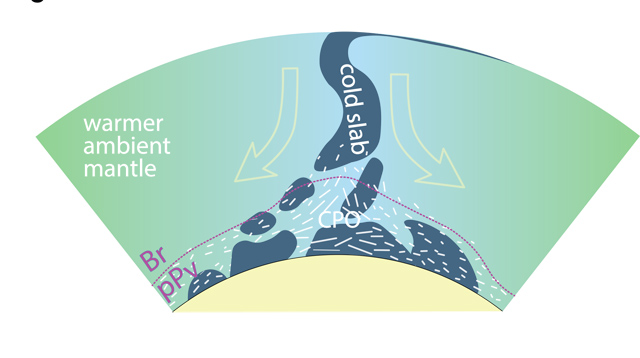
The researchers found anisotropy in about two-thirds of the lower mantle area they sampled. Although the pattern of anisotropy is complex, most of the anisotropy occurs in locations where scientists suspect there are deeply subducted slabs.
“This isn’t that surprising in a sense, because that is predicted by geodynamic simulations,” Wolf said. “But at the scale that we’re looking at, it’s not really been shown using those methods that we’re using.”
Researchers are still debating the source of seismic anisotropy in these subducted slabs, Wolf noted.
The slabs may hold some “fossil” traces of anisotropy from their time closer to the surface, but seismic anisotropy is more likely caused by severe deformation that these slabs undergo when they arrive at the core-mantle boundary, and the deformation of the material that they displace. The extreme pressure and heat of the mantle can also change the mineral phases in the slab as it descends, creating a different kind of anisotropic “fabric.”
Wolf also cautioned that the lack of anisotropic signal in some of the areas of their lowest mantle map doesn’t mean that anisotropy isn’t there. In some places, the signal may be too weak to be detected by their analysis, he said.
The massive dataset used in this study is a “treasure trove” that Wolf and his colleagues continue to mine for new insights into the deep mantle, he said.
“If I can dream, we will someday have enough information to really say much more about global flow directions of the lowermost mantle, knowing the seismic anisotropy across different lateral scales in the mantle, illuminating it from many directions,” he said.