

3 March 2026—The Seismological Society of America (SSA) announced today the appointment of Stefano Parolai as the next editor-in-chief of the Bulletin of the Seismological Society of America (BSSA).
Parolai is the current director of the department of mathematics, computer science and geosciences of the University of Trieste and full professor at the University of Trieste. He was appointed as editor-in-chief by the SSA Board of Directors.
BSSA publishes approximately 175 original papers every year that advance our understanding of seismology, seismic hazard and the entire spectrum of earthquake science.
“As editorial leader, Parolai will ensure BSSA’s continued importance and service to the community by recruiting the best submissions, maintaining the quality and integrity of the peer-review process, and serving as an ambassador for SSA and a visible champion for BSSA,” said SSA Publications Committee Chair John Townend, who led the search committee.
Parolai begins his term as editor-in-chief this summer and will succeed P. Martin Mai, professor of geophysics in the earth science and engineering program of the physical sciences and engineering division at KAUST, who began his five-year term at BSSA in 2021.
“BSSA is perhaps the most historically important journal in seismology,” said Parolai. “I’m honored to serve as editor-in-chief and make sure it remains the point of reference for all seismologists and anyone working in engineering seismology.”
Parolai’s research focuses on the study of seismic hazard and risk, the development of methodologies for assessing site effects including the use of surface waves and linear and nonlinear inversion methods, seismic signal analysis, seismic source and early warning systems.
He has broad experience and leadership roles with national and international projects related to seismic risk and monitoring (DFNK, SAFER, REAKT, MATRIX, Sibyl, EMCA, MODERN) as well as the organization and management of temporary seismometer networks installed in Germany, Italy, Greece, Turkey, Chile, Kyrgyzstan, Kazakhstan and Tajikistan.
Among his goals as editor-in-chief, Parolai would like to maintain the journal’s excellent reputation for peer review and the high quality of its papers, while expanding its author base and encouraging younger scientists to see BSSA as their research home.
“I think that what is special about BSSA, and the other two SSA journals, is that they are journals for our community,” he suggested. “It becomes quite natural to publish in SSA journals because you are part of the global seismology community.”
Parolai was the secretary general of the European Seismological Commission from 2014 to 2022. From 2017 to 2022 he served as the director of the Seismological Research Center of the National Institute of Oceanography and Applied Geophysics -OGS. Since 2012 he has been the director of the Center for Early Warning Systems section of the GFZ Helmholtz Centre for Geosciences.
He has been an associate editor of BSSA since 2008 and was a guest editor on the 2021 BSSA special issue on advances in site response estimation. Parolai’s own publishing record includes numerous works in BSSA as well as more than 200 publications in other peer-reviewed journals.
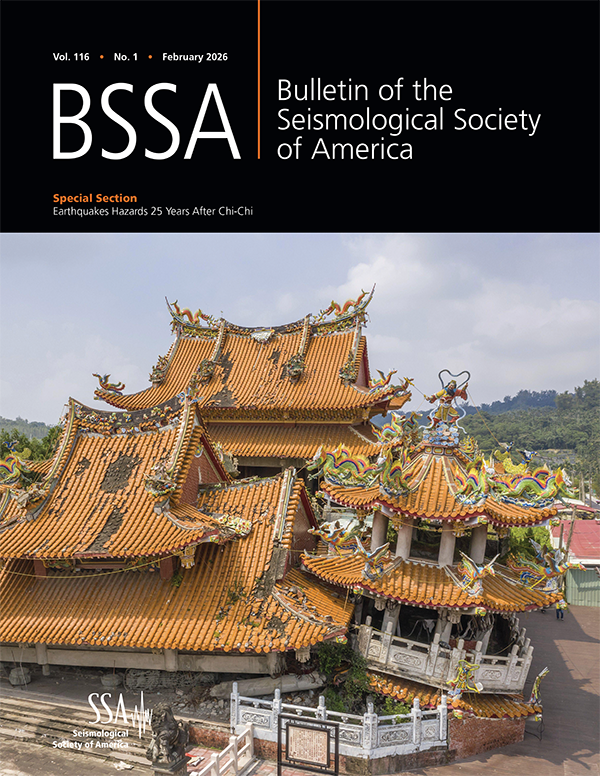
Parolai praised Mai for cultivating a wide variety of BSSA special issues during his time leading the journal, including issues on regional seismology in the Caribbean and Morocco; anniversary issues reviewing the state of the science after the Great 1923 Kanto, Japan earthquake and Taiwan’s Chi-Chi earthquake; and methodological advances in seismoacoustics, hazard, tomography and measurement of earthquake source parameters. During his tenure, Mai also relaunched the category of review articles for the journal.
Established in 1911, BSSA publishes original peer-reviewed research at the frontiers of seismology and earthquake system science. Its papers demonstrate a comprehensive and rigorous treatment of the subject that may include theoretical analyses, in-depth data analyses, advanced modeling and simulations, emerging techniques, methodological developments and applications. Invited review articles explore topics of broad interest to the community. Periodic special issues cover major earthquakes, new techniques and other advances in seismology. Authors may choose to publish their papers open access in BSSA.
To learn more about the journal, visit BSSA’s website.