15 June 2026—One hundred and fifty years of recorded earthquakes may sound like a lot of data, but it’s a drop in the bucket of the Earth’s 4.54 billion years, says Irene Liou.
 Liou, a postdoctoral researcher at the GFZ Helmholtz Centre for Geosciences, focuses on physics-based probabilistic seismic hazard analysis (PSHA) for her research. She includes numerical simulations of earthquakes in her seismic hazard estimations to inform gaps left by those billions of years of missing data.
“The fields of numerical ground motion simulations and PSHA are well-established; however, there are still obstacles in combining them,” Liou says.
“The challenge is we’re designing and predicting for rare ground motions, rare events,” she explains. “We often use simplified models of earthquakes to represent reality, and there are uncertainties in the inputs to the models. So that is a big challenge.”
One of her research goals is to make physics-based PSHA more accessible. Some of the challenges include validating the earthquake simulations used in these analyses and properly incorporating different types of uncertainties in the hazard calculations.
Liou also works with probabilistic fault displacement hazard analysis (PFDHA), which is “important for structures that cross active faults, and has the similar challenge of incomplete data,” she notes.
Her recent research in this field focuses on reducing variability between observations and predictions of fault displacement. But on a broader scale, Liou wants to advance work on a unifying framework that bridges concepts between PSHA and PFDHA.
Seismic hazard analysis has been a constant in Liou’s career, through academic and industry jobs. “You learn what speaks to you,” she says of the experience of different work environments. “It helps you become a better, well-rounded scientist, and you learn how to communicate with different types of people. I think it better equips me to see how my work can be accessible, whether it be in consulting or at a national laboratory.”
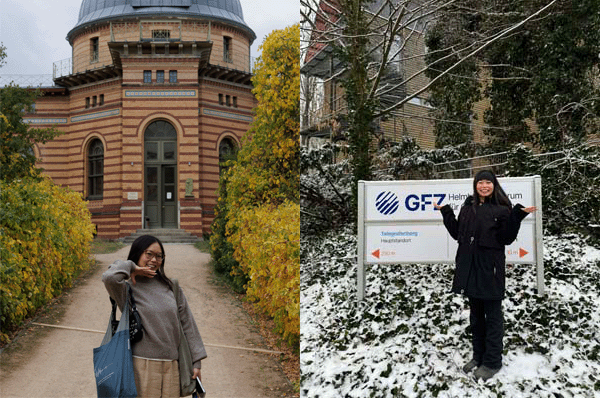
Liou’s journey to Germany and her position within the Helmholtz Centre’s Seismic Hazard and Risk Dynamics section began with a brief introduction to her “current boss” Fabrice Cotton at SSA’s 2023 topical meeting on physics-based ground motion modeling. Then at the World Conference of Earthquake Engineering in 2024, she ran into Cotton and invited him to visit her poster at the conference.
“I think putting yourself out there can lead to so many opportunities that you didn’t even know were possible,” Liou says. “It’s so exciting I get to be working in Europe right now.”
Arriving as an undergraduate at the University of California, Berkeley, Liou was determined to explore different classes and majors. “I tried music classes, architecture, and I just felt like something was still missing for me.”
Even before taking an earth science class, “I just knew it sounded so interesting,” she recalls. “I’d get to go on fun field trips outside. I would get to use physics, which I really enjoyed, and sketch diagrams and map rock formations. And I knew it had a very major societal impact, that studying hazards is so beneficial for society.”
During her Ph.D. program at the University of California, Davis, she “found it valuable to train as an engineer” and better apply her earth science knowledge to everyday challenges.
At the end of the year, Liou plans to return to California and join the California Geological Survey as an engineering seismologist. She says her dream job in seismology “would be one where I can do many things I enjoy and not be confined to just one thing. I have a background in both geophysics and geotechnical engineering, and would like to use both in supporting advancements in the earthquake community.”
“I’m excited to help support public safety by translating research into practical improvements, and I like being social,” she adds. “I don’t want to hide away at my desk.”
SSA At Work is a monthly column that follows the careers of SSA members. For the full list of issues, head to our At Work page.