16 March 2026—“I actually started in space and worked my way back to Earth,” says Kat Dapré.
During her Ph.D. with advisor Jessica Irving at the University of Bristol, Dapré began a six-month project on the seismology of Enceladus, the Saturn moon that has attracted lots of attention for its salty global ocean (a potential harbor for extraterrestrial life) beneath its thick ice shell.
The six months turned into her whole degree, “as I did more research and found new questions to investigate, chief among which was the complexity of Enceladus’ ice shell,” Dapré says. “By the end of my Ph.D. I had a bunch of new questions about cryoseismology that we don’t have answers for on Earth, let alone icy moons.”
Seeking those answers, Dapré is now a postdoctoral researcher at the University of Maryland’s ARROW (Antarctic Rift Research for Ocean Worlds) project, a deployment of seismic and geodetic instruments across a major rift zone on Antarctica’s Ross Ice Shelf.
“The Ross Ice Shelf is commonly used as an analog for faults in the icy shells of icy moons, especially Enceladus, so it’s an ideal case study for both planetary and terrestrial cryosphere science,” Dapré explains.
The project should help clarify on how the ice shell on Enceladus might respond under the stress and strain created by tidal forces, among other questions.
“Icy” seismology differs in some critical ways from traditional seismology, Dapré notes.
“The fundamental physics is the same, you’re just dealing with a different medium. Some of the most stark differences come from how closely linked the cryosphere is to liquid water and oceans—you get temperature-dependent seismic velocity in ice, for example, because of how much closer it is to its melting point than rocks are in more traditional seismology,” she says.
“And there are a lot of logistical differences, too— site accessibility, instrument lifespan, and infrastructure can all be a lot less forgiving in polar regions than they are on the continents, particularly if you want to deploy seismometers on floating ice like we have with the ARROW array at the Ross Ice Shelf,” Dapré added.
Dapré works on ARROW data that have been collected already, “so a trip to Antarctica sadly isn’t on the cards for me at the moment, but it means I get to spend a lot of time poring over the dataset and getting familiar with its quirks.”
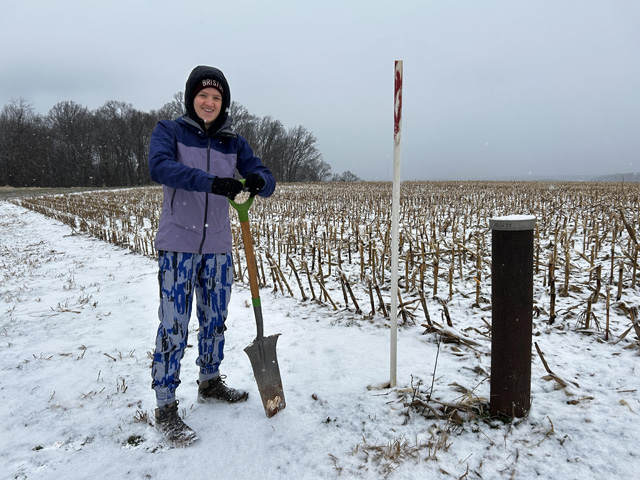
“I’m working on ambient noise techniques at the moment, and we’re doing a couple of much smaller-scale projects in much more accessible locations so we can test and compare methodologies somewhere closer to home—for example monitoring groundwater levels at a farming site in Maryland,” she says. “It actually snowed on the day we went to retrieve the instruments last month, which was not quite Antarctica but certainly made the buried seismometers harder to find!”
Sending a seismometer to Enceladus itself was “something of a pipe dream” when Dapré began her research, but she says the European Space Agency “is currently so keen to land on Enceladus as their next L4-class mission that they’re willing to dream up some pretty cool launch plans, involving two rockets and an assembly in space, to take a significant scientific payload there.”
In the meantime, Dapré and others await the 2028 launch of NASA’s future Dragonfly mission to explore another icy Saturn moon called Titan. “I’m really excited for the return of the Dragonfly data because it will be so interesting to evaluate how well we’re predicting the wavefields of these icy moons, which are so different to the terrestrial bodies where we’ve done seismology so far,” she says.
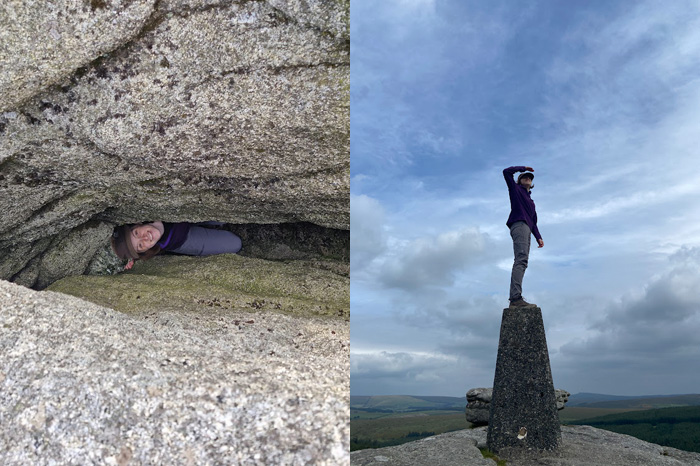
Dapré was “a pretty outdoorsy kid and was always enthralled by the granite tors in Dartmoor [national park in the United Kingdom] near my grandparents,” she recalls. “Learning that geology could explain where the towering piles of rock came from was something of a formative experience on my road to studying earth sciences.”
As she was finishing her thesis, she worked at a science center in Bristol, teaching children about meteorites and running planetarium shows.
“I remember one kid, who clearly knew his space trivia, who was utterly unconvinced that it was possible to see the stars from his garden, and I hope I managed to persuade him to have a look for them when he got home,” Dapré says.
“With public perception of the international space exploration scene starting to be dominated by tech billionaires instead of scientific motivations, it’s more important than ever that we keep communicating the awesome research we do. Planetary science is not only really cool, but it should also be inspiring!”
SSA At Work is a monthly column that follows the careers of SSA members. For the full list of issues, head to our At Work page.