
17 February 2026—Throughout his school years, Max Schneider was interested in math and science. But he also liked writing for local and campus newspapers. Then again, he enjoyed leading community service projects, cleaning up the beaches and volunteering in soup kitchens. And there was also his love of the performing and visual arts, starting all the way back in elementary school.
It took a year of college to work things out, but eventually Schneider decided he should major in … statistics.
“I realized that with statistics, I could probably do the widest range of problem solving,” he explains. “And then as I started to learn more about the sciences and what kind of skills that involved, I realized that they combined my passions for mathematical problem solving, for presenting complex topics in words and also on stage, and giving back to our larger society.”
Today Schneider is a statistical seismologist, working as a Mendenhall Postdoctoral Scholar at the U.S. Geological Survey. After undergraduate research applying statistics to problems from atmospheric chemistry to human rights, he now focuses on testing and communicating aftershock forecasts.
“I really think of earthquakes as a natural phenomenon and a physical phenomenon but also a social phenomenon,” Schneider says. “And so that piques the interest that I’ve developed in research in both the physical and social sciences.”
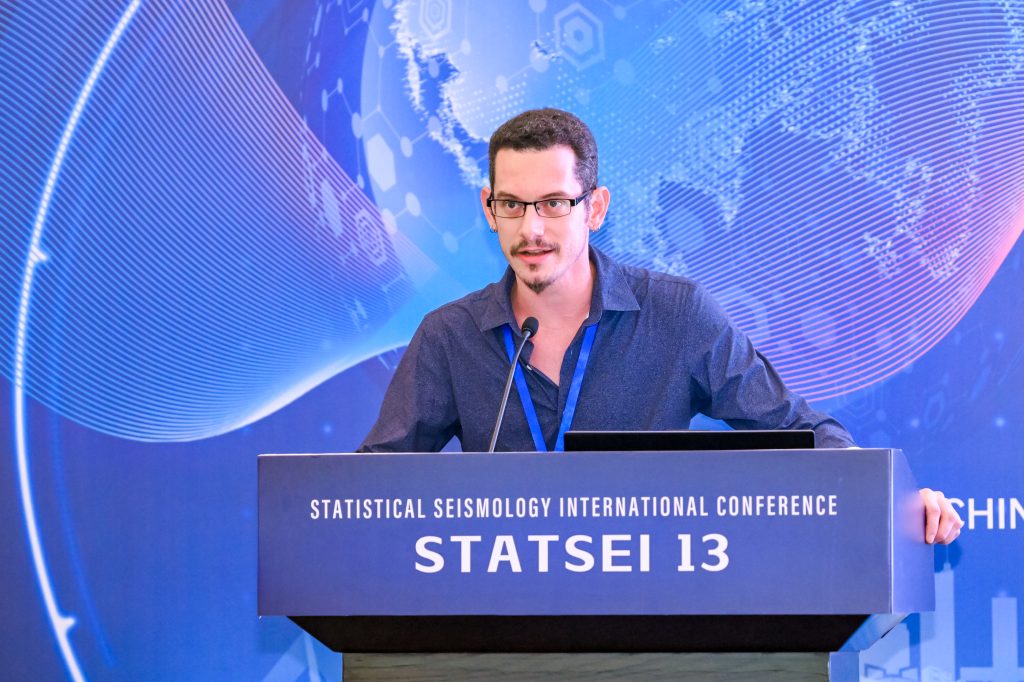
As an undergraduate at UCLA, Schneider worked with social science data, modeling human casualty data from several different natural hazards, including earthquakes. During an internship and subsequent master’s degree working at the German Research Center for Geosciences in Potsdam, Germany, he began thinking about earthquakes from a new perspective, statistically assessing how well earthquake forecast models matched observations.
“What’s funny is that I was testing models for California,” he recalls. “So I had to leave California and study earthquake forecasts for California in seismically very inactive Potsdam.”
Schneider returned to the U.S. to complete a Ph.D. at the University of Washington, where he began building his own earthquake models for the Pacific Northwest. There’s a lot of “lore” about how the region contains distinct patterns of earthquake and aftershock occurrences related to both their geographical location and also depth in the crust, he says, without a lot of data available to tease out these differences.
In a recent paper, Schneider and his colleagues describe the new statistical methods they used to “estimate the parameters in these aftershock models from this limited data set and also quantify the uncertainty,” he says. “So we can ask things like, is it really true that aftershock productivity differs between the deep subducting slab earthquakes versus the shallow crustal earthquakes?”
Aftershock forecasts are the fascinating counterpart to the usual caution that earthquakes can’t be predicted, he explains. There are laws of seismology that explain how many aftershocks can be expected after a mainshock, where those aftershocks are likely to be concentrated, how long we should expect them to last and roughly what magnitudes they will be. “So we can bake these seismological laws into a forecast model and forecast aftershocks, similarly to how we can forecast for storms or hurricanes,” says Schneider.
The next critical step, he adds, is figuring out how to best share these forecasts with their end users such as emergency managers, public health officials, civil engineers and the general public. At USGS, Schneider studies ways to refine maps and other visualizations to display aftershock forecasts and to communicate their uncertainty.
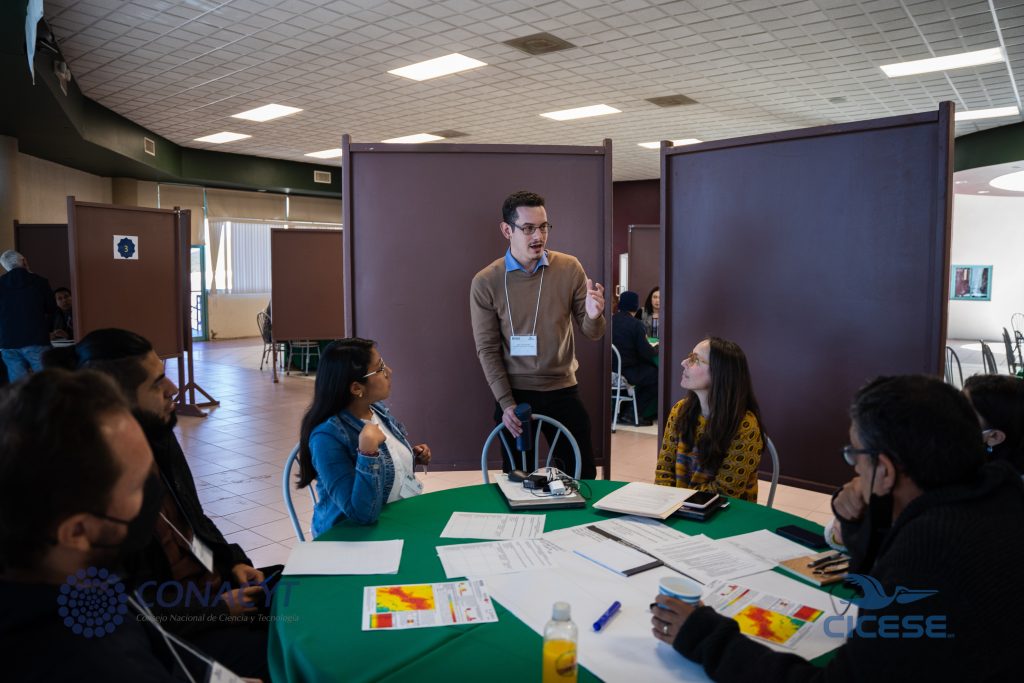
Most people already have trouble understanding probabilities or parsing big blocks of text, but the “biggest issue is the human part, which is that people are seeing forecasts, aftershock forecasts, usually for the first time ever, usually on the most stressful day of their life,” Schneider says.
He and his colleagues held workshops with end users in different professions and countries and worked with experts in risk communication and graphic design to improve how the USGS and other agencies communicate aftershock forecasts. User needs for aftershock forecasts were recently published and new prototypes for aftershock forecast graphics and maps have been tested with end users, with publications forthcoming, he says.
Schneider has another project in progress, to test how well the official USGS aftershock forecasts (produced in an automated system since 2018 for magnitude 4 and larger earthquakes) match with observed aftershocks. “Again here, the voice of the users will shape the metrics used to evaluate the forecasts and determine optimal forecasting choices,” he says.
It’s a long-term dream, he says, to bring together different groups around the world who have developed their own models to forecast aftershocks. Following a big earthquake, the teams would submit their real-time updated forecasts into a dashboard with human-centered products that visually communicate the forecasts and their uncertainties. Affected populations can use such a forecasting platform to make risk-informed decisions for earthquake response, recovery and rebuilding.
Earthquakes are his future for now, but Schneider doesn’t rule out working on other complex problems in applied statistics.
“I think on a fundamental level, there’s a lot of similarities between data on earthquakes, on atmospheric processes, on human rights. For those three, for example, they’re all varying in space and time. And accessing exactly what happened isn’t always possible. We have data sets that we know are incomplete,” he says. “But we still have to make data-driven predictions for these phenomena because they really affect society on a macro scale.”
SSA At Work is a monthly column that follows the careers of SSA members. For the full list of issues, head to our At Work page.