17 August 2026—A tire blew out during a family car trip through Kansas, but it wasn’t all bad news for eight-year-old Nate Stevens, who was eager to dig for fossils along the road.
“And then I started pulling out Inoceramid clam fossils, because anywhere in the middle of Kansas, you pick up a rock, there’s a fossil in it, because it’s an old seabed,” Stevens recalls.
The memory stayed with him as he looked at college majors. “The rest of my family is engineers, but I wanted to do earth science,” he says.
As a Penn State undergraduate, Stevens began his collaboration with cryosphere giant Richard Alley, analyzing Antarctic ice cores. The work was interesting, but moving into his master’s degree, “I kind of got the bug of wanting to do numeric things. I love the stories of geology, but I wanted numbers,” he explains.
And after a numerical modeling thesis modeling crustal stresses from ice sheet loading, what Stevens really wanted was “real numbers,” he says. “I love that we can do the ‘what if’ game with physics, and that’s so important. But the thing I wanted was real numbers, to be able to test a hypothesis down the line. And that’s when glaciology and geophysics came together for me.”
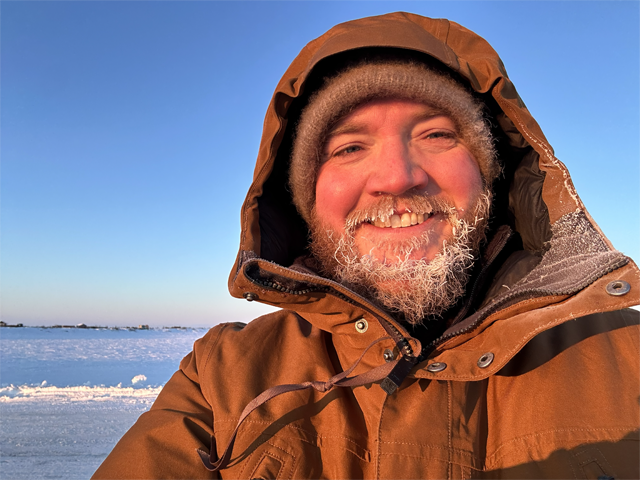 Despite his original focus on Antarctica as an incoming Ph.D. student at the University of Wisconsin-Madison, fuel logistics and COVID kept Stevens from the continent until he was a postdoc. The summer before lockdown, he and his fellow grad students recorded a treasure trove of data closer to home in the Canadian Rocky Mountains. “Saskatchewan Glacier made more ice quakes in three weeks than anyone else has ever seen from an Alpine glacier’s bed, so that was serendipitous,” he says.
Cryoseismology uses many of the same techniques as traditional seismology but “is a classic math problem of rescaling,” Stevens notes. “You work on tens of meters or hundreds of meters rather than tens of kilometers, so we’ve got a spatial rescaling. Frequency contents are very different, but you can rescale that as well.”
One of the hallmarks of early work in cryoseismology was researchers “grabbing tools that were in regular production in classic seismology and applying them as we needed, adapting them to our questions,” Stevens notes. “There was a sort of lag time between when something was developed in broader seismology and when cryoseismology picked it up, but that gap has shrunk over the past five to ten years.”
Today Stevens works as seismologist and developer for the Pacific Northwest Seismic Network. Cryoseismology remains part of his work at the PNSN, which collaborates with the USGS Cascades Volcano Observatory in real-time monitoring of Washington’s and Oregon’s glacier-clad volcanoes.
One of Stevens’ current tasks is finding ways to distinguish volcanic- and glacier-triggered seismicity at Mount Baker. Potential magmatic fluid migration “makes a bunch of low frequency events in the mid-crust,” he explains. “The glaciers also make low frequency events that look a lot like that.”
One way to distinguish them would be to pinpoint the depth of the seismic activity, but the current seismic network around Mount Baker limits that possibility, he says. Instead, he has been using template matching to detect and discriminate glacier sources.
He and his colleagues can see annual cycling of glacier-quakes in their results presented at last year’s SSA Environmental Seismology topical meeting. The signal was prominent when continuous waveform archiving started in the early 2000s, became more muted in the 2010s, and seems to be more prominent since then, “bleeding out of the peak months we typically see the signal, into other seasons, rather than just late summer into fall,” he says.
Another large project keeping Stevens busy is the migration of the PNSN’s real-time monitoring systems to a data center in downtown Seattle that is built to withstand a magnitude 9 earthquake. “I’m not formally trained as a software engineer,” he says, “so I’m learning those skills, and learning best practices from my colleagues that do have that training, and then implementing it the next day.”
Stevens also helps with PNSN public lab tours and is a regular participant on Skype a Scientist, which connects researchers with schools, families and libraries. “I think it’s really healthy for the public to talk with a scientist, and for them to hear us say, yeah, we’ve got a lot of the answers, but when we don’t know the answer, here’s how we might go about figuring that out,” he says.
Since the PNSN is run by a mix of state and federal employees, the recent federal furloughs have left some roles—especially duty seismologist—severely understaffed at times.
“But at the end of the day, when we talk with policymakers, it’s a pretty clear sell across the board that earthquake early warning is a good public service that warrants use of American taxpayer dollars,” Stevens says.
SSA At Work is a monthly column that follows the careers of SSA members. For the full list of issues, head to our At Work page.