15 January 2026— As an undergraduate, Umar Afegbua Kadiri already saw the Earth sciences as a “platform” for tackling complex, interdisciplinary questions about our planet. But his interest in seismology came after he completed his master’s degree, when Nigeria began experiencing a series of intraplate earthquakes.
 “At that time, seismology was unfamiliar in Nigeria, and few people were involved in it,” Kadiri says. “I saw it as an opportunity to expand my knowledge of Earth sciences and, at the same time, help my country understand the causes of low to medium magnitude earthquakes to reduce the impact of seismic risks on people and property.”
Kadiri now serves as assistant director and head of the Seismic Hazards and Risks Dynamics Unit at the Centre for Geodesy and Geodynamics, under Nigeria’s National Space Research and Development Agency. With his colleagues across West Africa, Kadiri focuses on expanding seismology research and monitoring capabilities for national and regional planning.
At the Centre, he supervises data acquisition, processing and analysis for Nigeria’s seismic and geophysical networks, while conducting seismic hazard assessment for critical facilities, among other key tasks.
Kadiri’s research interests in probabilistic seismic hazard assessment and ambient noise led him to an ongoing collaboration “with several African countries to perform comprehensive PSHA for the first time in their regions,” he notes.
“I am also working with a group of experts on the establishment of a Seismic Resilience Plan and National Earthquake Response System for Nigeria,” Kadiri adds. “This initiative is crucial, as the frequency of earthquake occurrences in Nigeria is increasing. My earthquake prediction model, which I developed during my Ph.D. research, indicates that Nigeria will continue to experience earthquakes with magnitudes below 4.0.”
Another part of his ongoing research uses machine learning to develop 1D and 3D velocity models and ground motion prediction equations for sub-Saharan Africa, hoping to learn more about the tectonic structure of the region.
West Africa, from Nigeria to Senegal, Kadiri notes, is generally considered to be seismically quiet. “However, it has experienced several significant historical and recent earthquakes. A notable event is the Guinea earthquake that occurred on December 22, 1983, which had a magnitude of 6.4.”
Kadiri’s research indicates that West Africa is characterized by stable continental crust, but the region features extensive transform faulting, deformation along the edges of older cratons, and active volcanoes.
“Balancing new research, technologies and programming with a busy schedule of official engagements is quite challenging,” Kadir says, noting that he makes it a priority to keep upgrading his skills and sharing continuing education with others.
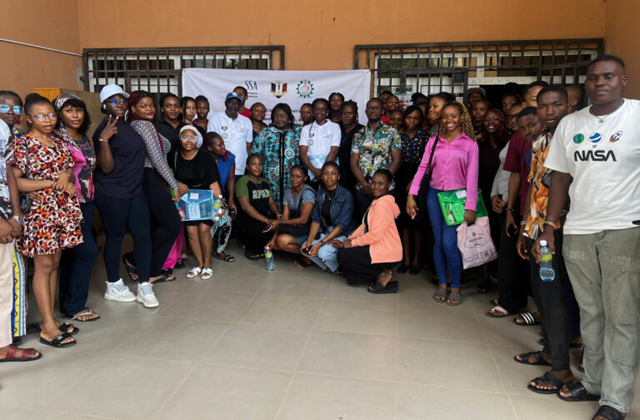
Held at the university, which hosts one of Nigeria’s active seismic stations, the five-day training focused on real-time data acquisition and analysis using the software, with applications spanning local and global networks.
Kadiri has a few dream projects in mind, he says, “if money and time were not barriers.”
He would like to conduct large-scale site response and vulnerability studies for critical facilities such as dams, bridges and conventional power plants to mitigate seismic risks. Another project would differentiate between earthquakes and artificial events at oil and other mining sites. He is keenly interested in collaborations with experts and members of SSA in research projects—national and international—in seismology and geophysics.
SSA At Work is a monthly column that follows the careers of SSA members. For the full list of issues, head to our At Work page.