
16 April 2026—Placed within a borehole drilled deep through the layers of a landslide, a fiber optic cable captured tiny, periodic stick-slip events that offer a unique glimpse at the complex movements within the landslide’s shear zone.
At the Lantai site in northern Taiwan, researchers concluded that the timing and pace of these stick-slip events was linked strongly to typhoon rainfall and earthquake shaking, they reported at the 2026 SSA Annual Meeting.
Recurring stick-slip events at the base of a deep-seated landslide like Lantai, where the sliding interface extends to the bedrock, have been detected on a few exceptional occasions using ground-based sensors prior to large failures, said Hsin-Hua Huang of Academia Sinica. In those cases, the stick-slip events were thought to be precursors to a major landsliding event.
“In contrast, our findings suggest that these stick-slip events are persistent rather than episodic—they are simply too minute to be detected by surface instrumentation under normal conditions,” Huang explained. “By leveraging borehole DAS sensing, we can now clearly ‘see them’ and characterize their spatiotemporal patterns for the first time.”
“Continuous monitoring of these repeating events may therefore offer a practical framework for developing accurate landslide early warning systems to mitigate future hazards,” he added.
DAS uses the tiny internal flaws in a long optical fiber as thousands of seismic sensors. An interrogator at one end of the fiber sends laser pulses down the cable that are reflected off the fiber flaws and bounced back to the instrument. When the fiber is disturbed by movement, researchers can examine changes in the reflected pulses to learn more about the resulting seismic waves.
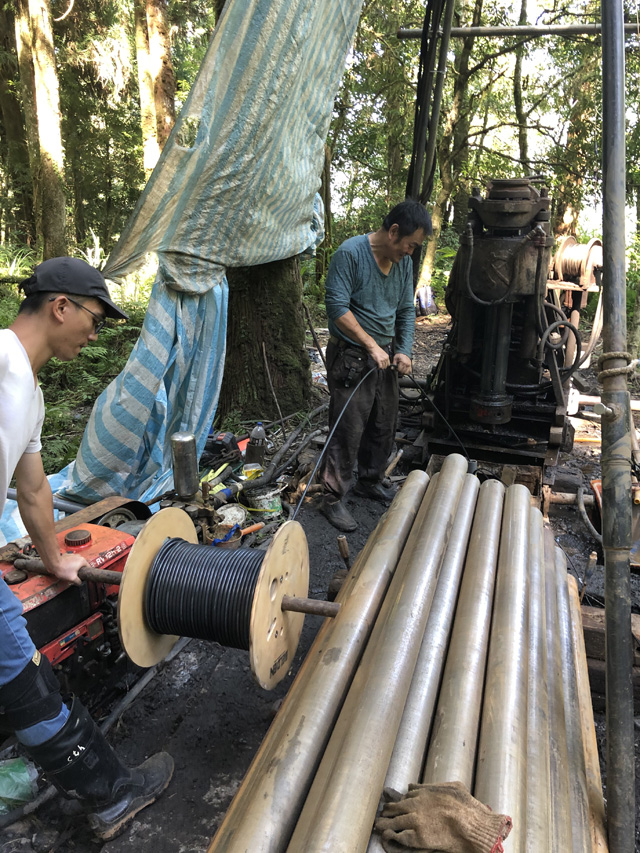
Researchers are using a host of geophysical instruments to monitor the Lantai site, but most of their observations are confined to the ground surface. And compared to other borehole instruments, DAS is easier and less expensive to deploy to the depths where the overburden of rock and soil slides against bedrock.
“These deep interfaces also entail a massive volume of material, and consequently, the resulting damage is catastrophic upon failure,” said Huang.
The research team at Lantai wanted to study the possible interaction between extreme environmental events such as typhoons and changes in the landslide’s structure. When a typhoon alert is issued for the area, the team deploys the DAS interrogator to the Lantai borehole for two weeks to a month.
During five of these DAS deployments, Huang and colleagues captured both accelerated landslide movements and recurring stick-slip events at the soil-bedrock interface, 20 to 30 meters deep.
Rainfall can trigger shallow landslides or debris flows, but “while rainfall is also considered a primary factor driving deep-seated landslides, the correlation is not as direct or immediate due to the depth of the interfaces,” said Huang. “Rather, it involves a complex network of fractures and fluid pathways that evolve dynamically during rainfall and are difficult to predict.”
DAS deployments like the one at Lantai can help scientists analyze how rainfall impacts frictional changes and other landslide mechanics at the landslide shear plane itself, which was “unattainable in the past,” said Huang.