
17 August 2026—Speakers at the 2026 Asia Oceania Geosciences Society (AOGS) conference, including an SSA editor and Board member, shared new research on why induced seismicity remains relevant for hydrocarbon and geothermal energy exploration.
Their presentations throughout the conference, held 2-7 August in Fukuoka, Japan, explained advancements in understanding the full geological context and physical mechanisms of induced earthquakes.
In her invited talk, Board Member Xiaowei Chen of Texas A&M discussed the factors controlling fault activation for fluid-induced sequences, using examples from wastewater disposal in Oklahoma and a geothermal injection test at Utah’s FORGE site. She noted that fluid-triggered changes in pore pressure can influence fault activation, but emphasized that differences in internal fault structures then control the subsequent evolution of an earthquake sequence. These stressed faults can remain active for a long time after fluid injection, Chen suggested.
Three presentations by SRL Deputy Editor Hongfeng Yang and his students at The Chinese University of Hong Kong discussed induced seismicity at the Weiyuan shale gas field in China, which has been connected to extensive hydraulic fracturing. Jinping Zi’s analysis of two magnitude 5 earthquakes that occurred in the region in 2019 detailed how the lithology of the area helped control the timing and arrest of the earthquakes, concluding that there was not just one route for induced seismicity triggering at the site. Yang shared results from Youjie Jiang and Aqeel Abbas on the complexity of stress perturbations that led to both normal and reverse-faulting types at Weiyuan, and how seismic attenuation can be used to track fluid flow underground.
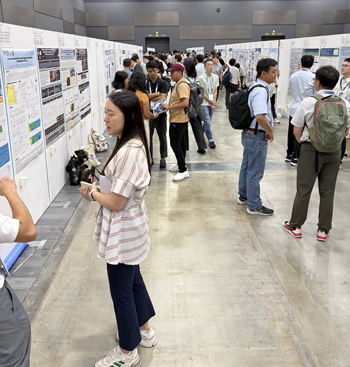 Yang, who serves as the president of the Solid Earth Sciences section of AOGS, also presented research on the challenges of identifying a unique, late-stage supershear rupture event for the 2021 magnitude 7.4 Maduo earthquake in the northeastern Tibetan Plateau. Interest in the origin and dynamics of supershear has grown with recent examples from Myanmar in 2025 and Türkiye in 2023. Yang shared results from a new algorithm he and his colleagues used to measure varying rupture speed for the earthquake, and explained why a geometrical bend near the end of the fault may have contributed to the Maduo supershear transition.
Other AOGS talks by SSA editors included a presentation by BSSA Associate Editor Jiancang Zhuang of the Institute of Statistical Mathematics on quantifying the predictability of the earthquake process. SSA 2027 Annual Meeting co-chair Aitaro Kato of the University of Tokyo led a session on the spectrum of fault slip that connects slow and fast earthquakes, with Yang and others.
Solid Earth Sciences sessions at the conference covered topics in magmatic and volcanic events and volcanic disaster prevention in Asia, seismic modeling and imaging, the evolution and dynamics of oceanic lithosphere, composition and structure of the Earth’s interior, machine learning in geophysics, Asian subduction zones, and tectonics and ore deposit formation, among other fields.
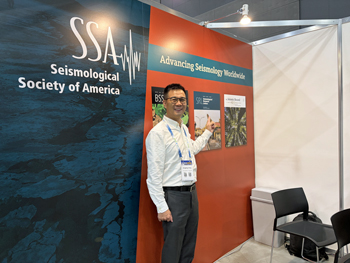
“There are a large number of earthquakes in Asia and Oceania regions. Some regions have limited sources of investigation and hazard evaluation, and thus SSA members may contribute,” said Yang, speaking about why SSA members may want to attend future AOGS conferences.
For students and other researchers who may not be able to travel to conferences outside the region, “meeting with global leading experts at AOGS would be their best options,” he added. “SSA members there can help broaden their education and outreach channels, as well as enhance global visibility and impact.”
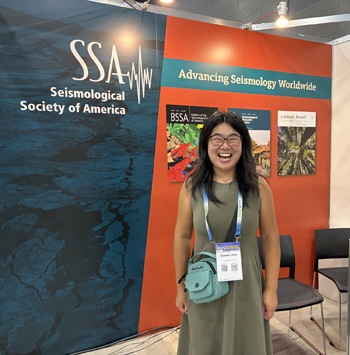
This year was the first time SSA has exhibited at an AOGS meeting. Staff shared information about SSA’s journals, including The Seismic Record’s initial Impact Factor and upcoming Calls for Papers. More than 50 student, early-career and low-income country researchers became new SSA members at the conference.