
17 April 2026—A massive Russian earthquake triggered swarms of tiny earthquakes in Pennsylvania, Massachusetts and New Jersey, according to a new report shared at the 2026 SSA Annual Meeting.
In July 2025, the region of Kamchatka, Russia was rocked by several large earthquakes, a sequence that ended in a magnitude 8.8 event that was the sixth largest earthquake recorded globally since 1900.
Half a world away, the seismic stresses of the Kamchatka events caused hour-long bursts and month-long swarms of earthquakes at places in eastern North America that until then had been seismically quiet, said Eric Beaucé, an associate research scientist at Lamont-Doherty Earth Observatory.
The North American earthquakes were tiny, mostly around magnitude 2. But they show a clear signal of being triggered by the Kamchatka earthquakes, he noted.
Beaucé identified the small earthquakes as part of his work to answer “the broader question of seismicity in what we call stable continental regions,” he explained. “Seismicity in places where we don’t really understand why there are earthquakes, because there are no tectonic forces, or at least there is no tectonic deformation that we can measure. But still we see these earthquakes.”
Increasingly, researchers like Beaucé are using automated techniques in places like eastern North America to mine the seismic record in search of small earthquakes. These data could help explain what triggers stress changes in the crust in stable regions.
“There is a hypothesis that seismicity in stable continental regions is particularly sensitive to small stress perturbations,” he said. “And the seismic waves radiated by these very large earthquakes, even though they are very distant, well, in some places it’s still enough for a little bit of seismicity.”
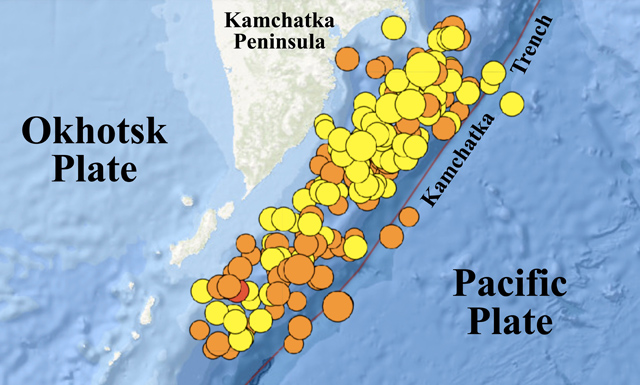
As Beaucé was tuning parts of his earthquake detection workflow, he decided to look through the eastern North America earthquake catalog to see if there was a change in seismicity after the 2025 Kamchatka earthquakes.
He and his colleagues have identified three earthquake sequences that they think are linked to Kamchatka, in northern Pennsylvania, New Jersey and Massachusetts.
The constant shaking of the Kamchatka event, which included several large foreshocks and aftershocks as well, “may have broke some pore pressure seals in the rock” in northern Pennsylvania to start a swarm of seismicity there, said Beaucé. “It seems like it initiated a swarm and then the swarm itself had some internal dynamics that kept it going for weeks.”
In New Jersey, Kamchatka seismicity led to an uptick in the rate of aftershocks that the region is still experiencing after the 2024 magnitude 4.8 Tewksbury earthquake, he added.
Beaucé and his colleagues continue to refine their estimates of each earthquake location so that they can look for potential patterns of migration among the eastern North American events. Measuring the speed and evolution of potential migration could shed light on the potential mechanisms, like reorganization of rock pore pressure, behind these earthquakes.
“We need to separate the contributions, the direct effects of these seismic waves [from Kamchatka] and then whatever processes that may be initiated by these waves that keep acting by themselves,” Beaucé said. “Because the triggering power of the seismic waves radiated by large earthquakes is really not well understood.”