
16 April 2026— If there is a magnitude 8 or 9 megathrust earthquake off the coast of the Pacific Northwest, data from ocean bottom seismometers (OBS) could improve earthquake detection times calculated by the ShakeAlert system.
At the 2026 SSA Annual Meeting, Zoe Krauss said ShakeAlert’s earthquake detection time could be improved by 5 to 9 seconds by incorporating data from six cabled OBS deployed offshore Oregon as part of the Ocean Observatories Initiative (OOI) Regional Cabled Network and five cabled OBSs deployed offshore Vancouver Island on Ocean Networks Canada’s (ONC) NEPTUNE cable.
There are currently only two cabled OBSs offshore Oregon, but the Cascadia Offshore Subduction Zone Observatory (COSZO) project will add four new OBS to the OOI network this summer, bringing these potential added detection times closer to reality.
If these cables could be converted into dense seismic arrays using distributed acoustic sensing or DAS, detection times could improve by up to 10-18 seconds, said Krauss, a postdoctoral researcher at the Pacific Northwest Seismic Network and University of Washington.
Further modeling by Krauss and her colleagues suggests that data from OBS and DAS offshore sensors could improve ShakeAlert’s estimates of earthquake magnitude and location as well.
Based on the current distribution of the OOI and ONC OBSs, these improved estimates translate to up to 40 seconds of additional warning time beyond the improved detection time for regional offshore earthquakes, the researchers conclude.
The goal of the study was to learn whether cabled OBS deployments could add value to the ShakeAlert system, said Krauss. “And we see that they add a lot of warning time. Just a little bit of coverage offshore, even though it’s limited in its spatial extent, makes a big difference.”
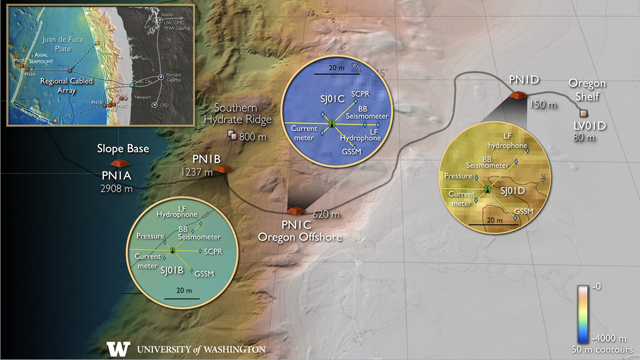
The Juan de Fuca plate starts to subduct beneath the North American plate about 100-150 kilometers offshore in the Pacific Northwest. “That’s what we call the deformation front,” Krauss explained. “In a large magnitude 9 earthquake, that’s kind of the absolute limit of where the earthquake will occur.”
The two cabled OBS in the Oregon network straddle this deformation front, about 20 kilometers apart. The next four will be placed further inland in a north-south curve. “Having stations closer to where the earthquake starts, your detection time is faster,” said Krauss.
More OBS are welcome, but DAS deployments would dramatically increase the sensor coverage available for earthquake detection and warning. It isn’t as easy to incorporate DAS data into the current ShakeAlert system, but Krauss said many researchers are exploring ways to make it work.
Krauss and others hope to eventually expand DAS data collection by partnering with telecommunications companies with fiber optic cables that cover much more of the global seafloor than scientific cable deployments.
These cables send data over thousands of kilometers with the help of signal boosters called optical repeaters. Until recently, DAS could only be used with the first 100 or so kilometers of a cable before being blocked by an optical repeater.
In a second presentation at the SSA meeting, Krauss described how technological advancements by collaborators at Nokia Bell Laboratories are breaking this barrier. The new system was tested for three months last winter on the offshore Oregon cable, “and now we have data beyond the repeaters, out to several hundred kilometers offshore,” said Krauss.
“We’ve learned a lot from this test data set and I’m excited about how we might be able to use this technique going forward,” she said.