
REVISION issued May 6, 2026:
The original release stated in its seventh paragraph that, “An uncontrolled explosion of a subcritical experiment could potentially release radioactive material at levels harmful to workers within PULSE as well as nearby Nevada communities.”
The Defense Nuclear Facilities Safety Board has asked this sentence to be revised to read as it does below.
15 April 2026—The underground laboratory in Nevada where the U.S. conducts nuclear subcritical experiments is riddled with faults.
Researchers have not confirmed whether any of these faults are active and could rupture during an earthquake, according to a presentation by members of the Defense Nuclear Facilities Safety Board delivered at the 2026 SSA Annual Meeting.
During a 2024 safety review, the Board found documentation detailing extensive faulting and faulting-associated phenomena such as rock displacement within the Principal Underground Laboratory for Subcritical Experimentation or PULSE at the Nevada National Security Site.
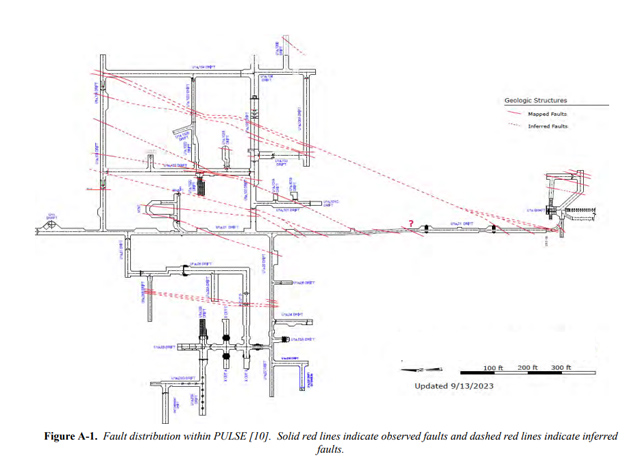
Although faults in the facility have been documented since at least 1989, personnel from the National Nuclear Security Administration and the Nevada National Security Sites have not studied them to determine whether they are active, the Board noted in a July 2024 letter to U.S. Secretary of Energy Jennifer Granholm that detailed their findings.
Within PULSE’s underground drifts, about 1000 feet below the surface, scientists conduct what are called subcritical experiments, which consist of special nuclear material mated with high explosives. The experiment is designed to prevent a self-sustaining nuclear reaction while providing valuable data on the reliability and viability of stockpiled nuclear weapons.
The 2024 safety review was triggered by plans to enlarge the PULSE laboratory and expand its diagnostic capabilities. The review concluded that the design of existing and new seismic safety controls within PULSE “do not account for the effects of seismic shaking and displacements caused by the faults within the facility.”
An uncontrolled explosion of a subcritical experiment could potentially release radioactive material at levels harmful to workers.
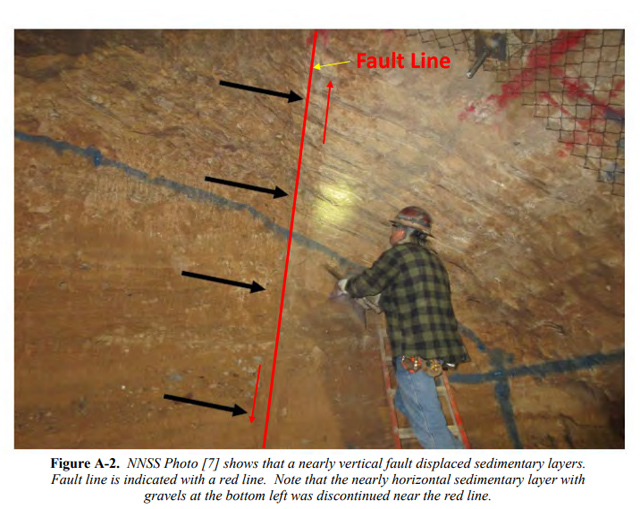
gravels at the bottom left was discontinued near the red line. | Defense Nuclear Facilities Safety Board
“Our main concern is if there’s an earthquake and it causes something to topple on top of the experimental package when outside of a container, setting it off,” said Austin Powers, an engineer at the Defense Nuclear Facilities Safety Board. “The infrastructure and overhead equipment in the experimental operations area need to be designed so they are seismically qualified to not fail. If these faults are active, we would want that to be considered in the design.”
In a December 2024 response to the Board, the Department of Energy said the National Nuclear Security Administration “is developing a plan to perform a more detailed investigation of the historic seismic activity of the faults in the PULSE vicinity.” However, no action has been taken to date.
Yong Li, a senior scientist at the Defense Nuclear Facilities Safety Board, and colleagues visited PULSE to observe and measure the faults inside its tunnels and drifts. They observed fault evidence in many locations throughout the underground lab, including signs of rock displacement and slickensides, the polished rock faces created by the friction of rocks moving against each other in a fault plane.
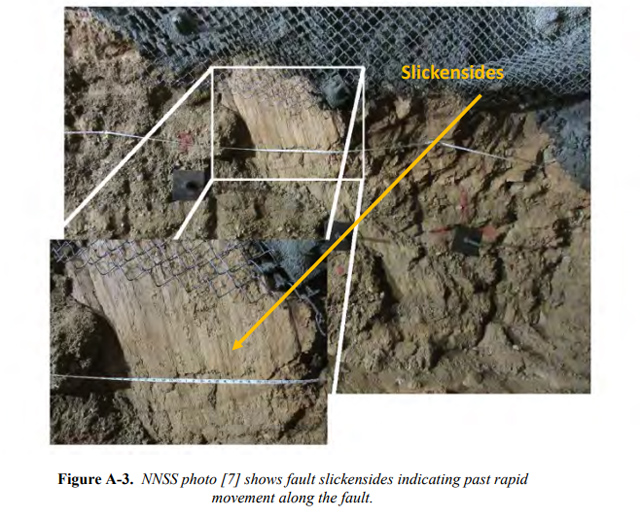
movement along the fault. | Defense Nuclear Facilities Safety Board
Without further analysis it’s unclear how much fault displacement would occur during a seismic event. However, the researchers suggest in their report that it could be 17 feet or more, based on evidence indicating that offset exceeds the highest drift height of 17 feet.
Displacement “can disrupt the tunnel structure itself,” said Li. “But another aspect is that if these faults are active, there could be vibrational concerns” that should be accounted for in seismic safety designs.
Li said previous researchers documented many of these PULSE faults, mapping their distribution and trying to establish their relationship with surrounding regional fault systems, “but they never discussed their age.”
“They have the distribution of these faults, including their geometry and attitudes but the key point missing was how old are these faults,” he said.
In their response to the Board’s letter, the Department of Energy said the PULSE faults “do not currently qualify for inclusion” in the U.S. Geological Survey’s Quaternary Fault and Fold Database, which is used to assess nationwide seismic hazard. The database includes faults that have shown evidence of movement in the past 1.6 million years and can produce magnitude 6 or larger earthquakes.
The annual number of experiments at PULSE has varied throughout the years, Powers said, “but with the expansion of the underground facility to increase its capabilities, they anticipate the number of experiments to also be going up.”