
17 April 2026—Thawing permafrost buried underneath rivers may be accelerating permafrost degradation faster than previously estimated in these inundated regions, according to new research shared at the 2026 SSA Annual Meeting.
Haoyuan Sun of Zhejiang University and colleagues used distributed acoustic sensing (DAS) on an existing telecommunications cable to develop a uniquely detailed look at the permafrost dynamics in river channels on the Qinghai-Tibet Plateau.
Their models based on the DAS data suggest that “river-induced warming may accelerate thaw progression on the order of 15%, compared with simulations based on more conventional parameter choices,” said Sun.
Permafrost regions are disappearing as the planet warms. Melting permafrost can release stores of potent greenhouse gases such as methane that further accelerate climate change. As the supportive permanent frozen layer melts, the ground shifts and slumps, causing damage to roads, buildings and pipelines.
Sun and colleagues found a thicker than expected “active layer” of permafrost beneath rivers. The active layer is the near-surface part of permafrost that thaws in warm seasons and re-freezes in cold seasons.
“We expected the river to enhance thawing to some extent, since flowing water can transfer heat into the surrounding ground and maintain warmer subsurface conditions than nearby dry land,” Sun explained. “So the presence of a thicker active layer beneath the river was not unexpected.”
“What was particularly striking, however, was how clearly and consistently this contrast appeared when comparing the inundated zone with adjacent non-inundated areas,” he added.
The river corridor “acts as a localized zone of enhanced thaw,” said Sun.
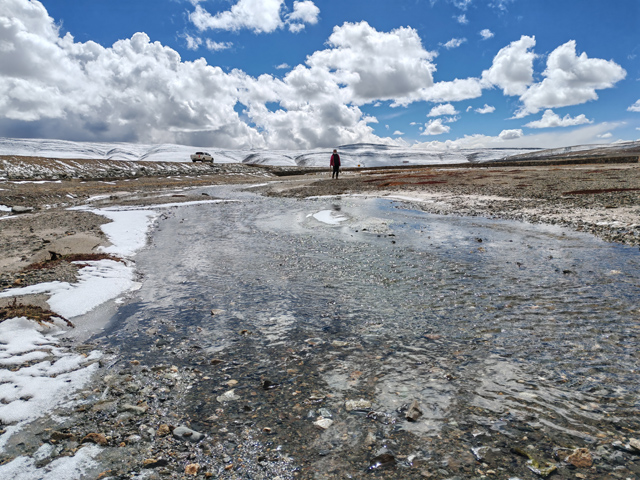
To better understand local heat transfer, the researchers used DAS to gather a snapshot of the actual thaw state under rivers. Many traditional studies of this phenomenon are based on generalized assumptions about heat flow, the researchers noted.
DAS turns a single fiber-optic cable into thousands of tiny seismic sensors. Compared to traditional seismic monitoring stations, DAS provides extremely dense seismic coverage of a region without digging boreholes or otherwise disturbing the ground. “This is especially important in environmentally sensitive permafrost regions,” Sun said.
Seismic waves move at different velocities depending on whether they are traveling through frozen or thawed ground. The researchers analyzed the wave data collected by the DAS deployment to estimate the seismic velocity structure under the rivers.
“By mapping these velocity contrasts with depth and along the cable, we can identify the boundary between the active layer and the underlying permafrost,” Sun explained.
The high spatial resolution provided by the DAS array “enabled us to detect small-scale variations in thaw depth that would be difficult to capture with sparse measurements,” he added.
Based on the DAS data, Sun and colleagues suggest the heat transfer is about 30% higher than typically calculated for permafrost under rivers.
“While this does not translate directly into a 30% increase in thaw rate, it does imply a faster thermal response, corresponding to roughly a 15% increase in thaw progression,” Sun said.
If cold region climates become warmer and wetter in the future, their model suggests enhanced permafrost thaw will increase risks to riverside infrastructure, the researchers concluded.