
16 April 2026—In subduction zones, the sites of the world’s largest earthquakes, tectonic activity may generate a “pump” that transports long-buried subseafloor microbes back toward the seafloor, according to research presented at the 2026 SSA Annual Meeting.
These microbes are the world’s most dedicated sleeping beauties, lying dormant for thousands or even millions of years beneath a kilometer-deep blanket of ocean sediment. They survive this prolonged dormancy with the help of a range of specialized adaptations.
But to pass on these adaptations to the next generation, the microbes must eventually reach the shallowest layers of the seafloor where they can eat, grow and disperse.
That’s where the tectonic pump comes in, said Zhengze Li, a Ph.D. student at the University of Southern California.
Li and his colleagues suggest that fault slip in subduction zones drives fluid flow that transports long-buried subsurface microbes back toward the seafloor. According to their models, this tectonic pump could circulate more than 1 million gigatons of fluid per million years, potentially transporting up to 1030 microbial cells.
At the meeting, Li explained how this microbial “elevator” might work. In subduction zones, where one tectonic plate descends beneath another, layers of sediment on the downgoing plate are scraped off and accumulate in a wedge against the overriding plate.
Some of the deep, dormant microbes remain on the downgoing plate and continue their descent beneath the overriding plate toward the mantle, a journey Li and his colleagues call “the trip to hell.”
Microbes that avoid that fate, however, may be transported upward through fractures and faults in the sediment wedge, or more diffusely through the sediments, driven by subduction-related slip.
Relocated to the shallow seafloor, the microbes “can now be reactivated and can reproduce,” Li said. “The full cycle—from burial and transport with the subducting plate to eventual return—can take tens of millions of years or longer.”
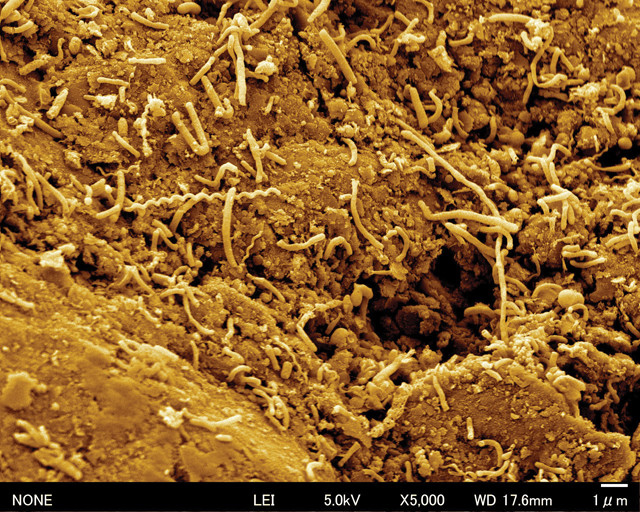
Cold seeps on the seafloor, where fluids are preferentially discharged from the subseafloor, provide direct evidence of active fluid transport and are consistent with ongoing tectonic pumping. These seep sites also offer accessible windows for sampling microbial communities, enabling further evaluation of the relationship between tectonic processes and subseafloor microbial life.
“We can also examine how seismic activity relates to the relative abundance of different microbial groups, and we find a positive correlation between seismic energy and the abundance of subsurface-associated microbes,” Li said.
The researchers have examined this idea in the subduction zone of Costa Rica and found that higher seismic energy indices are associated with greater relative abundance of microbial taxa typically found in subsurface environments.
Tectonic pumping is not limited to large earthquakes, Li added. Even seismically “silent” slow slip events, tremor, and aseismic creep can generate stress perturbations that drive fluid mobilization and microbial transport.
Research by Li’s coauthor Karen Lloyd, a professor of microbial biogeochemistry at USC, and others has identified a range of adaptations that allow deep-buried microbes to survive long-term dormancy, including DNA repair mechanisms and enzymes that enable the degradation of organic matter at depth.
Genomic studies further suggest that mutations in these microbes often act to preserve traits over thousands to millions of years.
For a chance to pass on these adaptations and undergo genetic innovation, the microbes have to wait for the tectonic elevator to bring them to a more hospitable realm.