
4 December 2025—Thanh-Son Phạm calls himself a “method developer.” As a seismologist, this means that his interests are to develop ways to reach from the Earth’s inner core to the ice sheets of Antarctica.
Phạm, a research fellow at the Australian National University, discovered the geosciences after studying mathematics and physics, which may help explain his interest and expertise in methods, he suggests.
After earning his bachelor’s degree in applied mathematics and informatics from Hanoi University of Science and Technology in Vietnam, he was awarded one of 10 scholarships from the Abdus Salam International Centre for Theoretical Physics in Trieste, Italy, for students from developing countries.
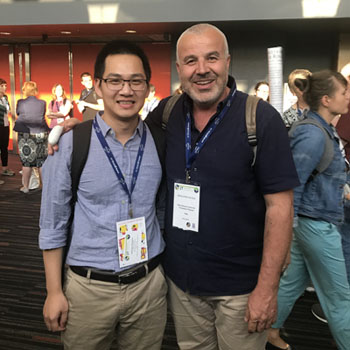
Karim Aoudia, a geophysicist at ICTP who passed away in October 2025, had a lasting impact on Phạm. “He was an inspiring mentor whom I was fortunate to meet,” he says. “He influentially encouraged me to pursue a career in science, specifically in geophysics.”
Coursework in Earth system physics with Aoudia led Phạm to a seismology Ph.D. at ANU. “Perhaps it was the field where my academic strengths in maths, physics, and scientific programming could all be useful together,” Phạm says.
The method Phạm developed during his Ph.D., called coda-correlation wavefield, extracts information from the long seismic signature called the coda at the end of earthquake records. He and his Ph.D. supervisor Hrvoje Tkalčić used the technique to study the Earth’s inner core, publishing several key papers that have provided new data on the properties of the inner core.
“It should be clear that the study of the Earth’s inner core is a challenging endeavor,” Phạm says. “It is more than 5,000 km beneath our feet, so we do not have any direct measurements about it. Also, the inner core is tiny in size. Its diameter is less than one-fifth of the Earth’s, meaning it is just less than 1% of the Earth’s volume.
“In my view, the community is clearly moving away from simple, first-order inner-core models,” Phạm notes. “With the availability of more seismic data and the ways we analyze them, together with sophisticated methods for analyzing materials at high pressure and temperature, we are learning more about the complexity of its structures and dynamics.”
“When it comes to the deep Earth, we are still at the discovery stage,” he adds. “Perhaps this is why this field remains fascinating!”
Phạm’s publications on the inner core, and more recently on the climactic 2022 Hunga (Tonga) eruption, have received significant media attention. He has a few tips for seismologists facing reporters: “I think my first tip is to do homework well. I often prepare up to three key points that I want to convey to the press about my research,” he explains. “Too much information may confuse journalists—they may not have a background in your field.”
“Secondly, prepare some simple analogies to explain complex concepts in your research,” he suggests. “It’s often effective to compare abstract ideas to daily objects or phenomena.”
Phạm’s other recent research focus is the study of large ice sheet dynamics and glacial earthquakes in polar regions. In keeping with his identity as a method developer, Phạm created a simpler version of the coda correlation method called P-wave coda autocorrelation, “which uses data from a single station to image Earth’s shallow structure,” he explains.
The method was used at the start of Phạm’s Ph.D. to study the Antarctic ice sheet. Since then, Phạm continues to study Antarctic glacial seismicity (he presented this research at the 2025 SSA Environmental Seismology meeting) and the dynamic interactions between the Antarctic ice sheet and the ocean.
“Both studies of the inner core and Antarctic ice sheets rely on fundamental understandings of seismic sources and wave propagation,” Phạm says. “They are not very different in seismological terms. Also, they are both ‘remote’ places on Earth.”
“Antarctica is a special place to do research. It plays a crucial role in the Earth’s climate and environmental systems. It is also the door to studying the deep Earth’s interior, such as the inner core, as it is the only landmass near the Earth’s pole,” he notes.
Phạm’s dream project is to deploy a dense network of autonomous seismometers on the southern ice cap. “I think it can definitely help us learn many exciting things about the Earth’s system as a whole,” he says.
SSA At Work is a monthly column that follows the careers of SSA members. For the full list of issues, head to our At Work page.