
13 April 2026—Zhigang Peng studies the physics of faulting, earthquake triggering, fault zone structures, earthquakes swarms, slow earthquakes, but lately he’s added a few other topics that veer away from the usual. Vibrations in a sewer pipe. Exploding rock outcrops.
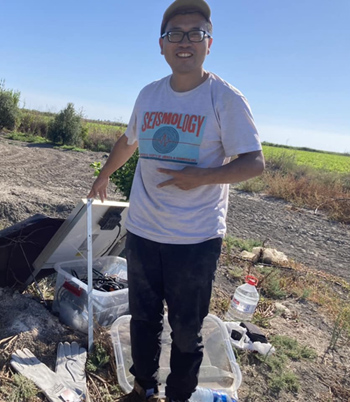 “In particular, what I have been working on the past 20 years is primarily understanding how earthquakes interact with each other, and in some cases, how other processes interact with earthquakes,” explains Peng, a professor in the Georgia Tech School of Earth & Atmospheric Sciences and incoming SSA president.
But his more recent work deploying nodal seismometers in and around Georgia has led him “almost by accident” into the field of environmental seismology.
The rise of nodal seismometers, fiber Distributed Acoustic Sensing (DAS) and machine learning have combined to produce a wealth of seismic data, and “pretty quickly you realize that there are actually quite a lot of non-earthquake events that are also there in the data,” he says.
“If you really wanted to study earthquake events, you better learn to distinguish or throw out those non-earthquake events first. But it turns out that some of those events are also equally interesting or sometimes more interesting, depending on where you are studying,” Peng adds.
Environmental seismologists are turning noise into signal to study a variety of phenomena, from urban traffic to groundwater levels. Peng and his colleagues used seismic sensors to analyze periodic vibrations from shaking homes nearly every six minutes in a neighborhood outside of Atlanta, for instance, discovering that a faulty check valve in a sewer pipe was producing a water hammer effect.
And then there are the exploding rocks. In July 2023, there was a violent spalling of rock off the face of Arabia Mountain in Georgia that scattered large chunks of gneiss. “Normally on these outcrops the outer layer of bare rock can peel off slowly, but in some cases they kind of blast off violently and generate some ground shaking,” Peng says.
He and his students and collaborators deployed seismic instruments and temperature sensors to Arabia Mountain in summer 2024, collecting data on a few more spontaneous exfoliations that the researchers believe are thermally induced. One event was even caught on camera (see below).
“It’s a unique way to study how rock kind of disintegrates itself, and that’s basically the beginning of the erosion process, but I also kind of view it as almost an analogy to study how big earthquake faults behave,” says Peng. “Of course, the driving force is different, but in this case I can look at these behaviors occurring much more frequently, much closer in distance and with more observations.”
The researchers are looking for precursor signals for the rock bursts, to try to predict when the events will happen. “If we can learn from that process,” explains Peng, “that could provide feedback to our big problem, which is to maybe hopefully one day forecast when the next big earthquake is going to happen.”
Aside from conducting earthquake research, Peng has been working on turning seismic data into sounds and music that a lay person can understand and appreciate, a process called “sonification.” His most recent efforts involve sonifying high-resolution deep tremor catalogs around the world with Piano Keys. Those tremor events typically migrate along major plate boundary fault strike and can be converted into moving piano key strokes that mimic the classic Tom & Jerry “Concert Madness.”
One event that Peng hopes to study again before he retires is the next magnitude 6+ earthquake on the Parkfield section of the San Andreas Fault in central California. These sequences occur every 22 to 40 years, making them an interesting laboratory for testing the latest in seismic instrumentation and theory for earthquake nucleation. One of his dream projects, Peng says, is to densely instrument the fault from the surface to deep boreholes using everything from DAS to strain measurements and geochemical measurements to capture a full picture of the next Parkfield earthquake.
“We have learned a lot from the previous Parkfield, California Earthquake Experiment,” says Peng. “It would be fun to do it again, with the latest instruments and tools. We are only halfway through the next earthquake cycle, and there is plenty of time to get ready”.
Peng has been a part of the SSA community ever attending his first SSA Annual Meeting in San Diego in April 2000. He was recognized for his outstanding early-career research as the 2010 Charles F. Richter recipient. He served as an associate editor for the Bulletin of the Seismological Society of America from 2011 to 2013 and was the Seismological Research Letters Editor-in-Chief from 2013 to 2019. His work in expanding SRL’s reach and prestige was cited in 2020 when he received the Distinguished Service to SSA Award.
Peng says one of his goals as SSA president will be to continue expanding SSA’s presence through international collaborations and visits. He and other SSA members, including SSA past president Heather DeShon, recently represented the Society at the 2026 International Conference on Intraplate and Himalayan Seismology in India.
“While I was there, I talked to quite a few students and early career researchers from India and surrounding countries, and they see the benefits and are interested in getting more engaged with SSA,” he notes. “I started as an international student and settled down in the U.S. nearly 30 years ago. And that is one thing I hope to do, to maybe bridge and make more connections to other societies around the globe that are relevant to SSA as well.”
SSA At Work is a monthly column that follows the careers of SSA members. For the full list of issues, head to our At Work page.